



















By Ebi Kesiena
The United Arab Emirates and Nigeria have taken a major step toward strengthening bilateral economic relations with the signing of a Comprehensive Economic Partnership Agreement (CEPA), aimed at expanding trade, investment and long-term cooperation between the two countries.
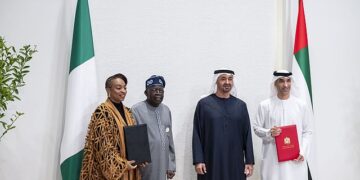
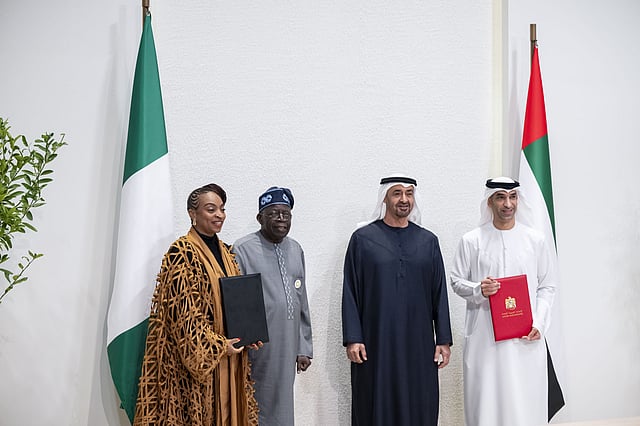
President His Highness Sheikh Mohamed bin Zayed Al Nahyan and Nigeria’s President, Bola Ahmed Tinubu, witnessed the signing ceremony in Abu Dhabi on Tuesday, underscoring the strategic importance both nations attach to the agreement.
The CEPA marks the beginning of a new phase in UAE–Nigeria relations, designed to unlock fresh opportunities for commerce and investment. Sheikh Mohamed described the agreement as a milestone that reflects the UAE’s commitment to deepening global trade partnerships and fostering shared economic growth. He noted that the deal aligns with the UAE’s broader strategy of building mutually beneficial economic ties with key partners around the world.
President Tinubu, in his remarks, highlighted the agreement’s potential to open new avenues for trade and economic cooperation. He reaffirmed Nigeria’s commitment to fully implementing the partnership in a manner that advances the development priorities and economic ambitions of both countries.
The agreement was signed by the UAE Minister of Foreign Trade, Dr Thani bin Ahmed Al Zeyoudi, and Nigeria’s Minister of Industry, Trade and Investment, Dr Jumoke Oduwole, on the sidelines of Abu Dhabi Sustainability Week.
Under the CEPA, both countries will work to reduce tariffs and eliminate non-tariff barriers to trade, a move expected to significantly increase investment flows. The agreement also targets expanded collaboration in key sectors including technology, agriculture, energy and precious metals. In addition, it seeks to enhance public and private sector partnerships, strengthen supply chains and support small and medium-sized enterprises (SMEs) in accessing global markets.
The UAE–Nigeria CEPA represents a key pillar of the UAE’s foreign trade agenda and builds on a long history of economic engagement between the two nations. Bilateral non-oil trade reached $4.3 billion in 2024, reflecting a 55.3 per cent increase compared with 2023, highlighting the growing momentum and shared commitment to sustained economic growth.