













By Emmanuel Nduka Obisue
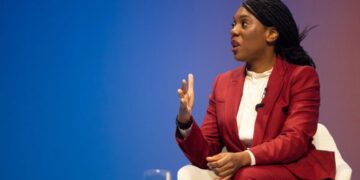
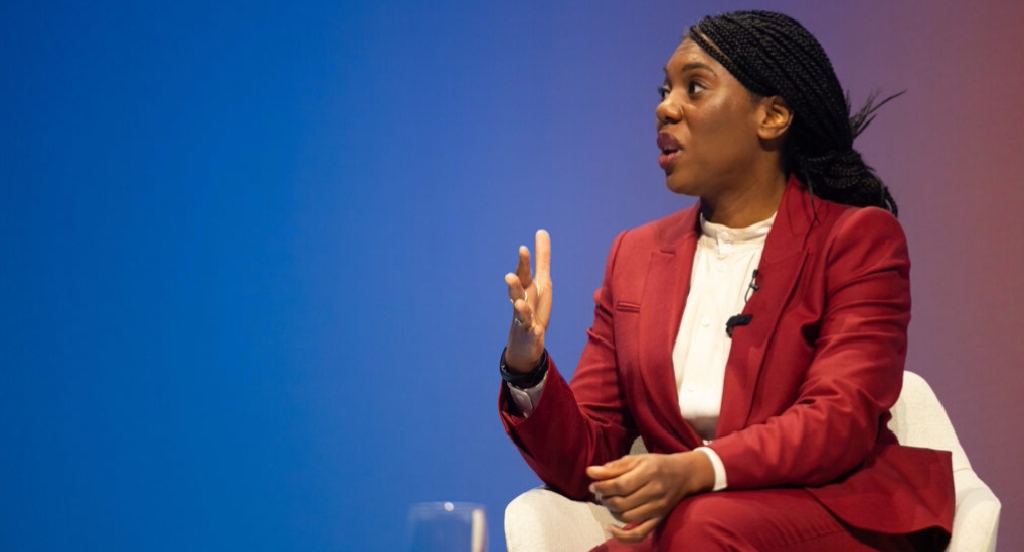
UK Conservative Party leader, Kemi Badenoch, has dismissed former leadership rival Robert Jenrick from her senior policy team and suspended him from the party over allegations that he was secretly plotting to defect to another political party.
Badenoch announced the decision on Thursday, accusing Jenrick of working behind the scenes to undermine the Conservative Party at a time it is battling declining support and growing momentum for the right-wing Reform UK party.
The move followed public claims by Reform UK leader, Nigel Farage, that he had held discussions with Jenrick about a possible switch of allegiance. Farage’s remarks intensified speculation over Jenrick’s political future and prompted swift action from the Conservative leadership.
Jenrick, who lost to Badenoch in the 2024 Conservative leadership race after the party’s heavy general election defeat, had been appointed Shadow Justice Secretary as part of efforts to reunite the divided opposition. In the role, he became increasingly prominent on issues such as immigration and crime, fuelling speculation that he was positioning himself for a future leadership challenge.
In a statement posted on X, Badenoch said she had acted after receiving what she described as “clear, irrefutable evidence” of Jenrick’s intentions. “I have sacked Robert Jenrick from the Shadow Cabinet, removed the whip and suspended his party membership with immediate effect,” she said.
Although she did not name the party Jenrick was allegedly planning to join, Badenoch said the move was calculated to inflict maximum damage on the Conservatives.
“I was presented with clear, irrefutable evidence that he was plotting in secret to defect in a way designed to be as damaging as possible to his Shadow Cabinet colleagues and the wider Conservative Party,” she said. “The British public are tired of political psychodrama and so am I. They saw too much of it in the last government, they’re seeing too much of it in this government. I will not repeat those mistakes,” she added.
In a separate statement, Badenoch announced the appointment of Nick Timothy as the new Shadow Justice Secretary. “Delighted to announce that Nick Timothy is the new Shadow Justice Secretary. As an MP, Nick has led the way in revealing the failure of the West Midlands Police Chief over the Maccabi football ban, and in opposing Labour’s sinister Islamophobia definition.
“He is a true Conservative, brings a wealth of experience, and is a formidable campaigner. Nick will be a massive asset to the Shadow Cabinet team as we continue to develop our plans for a stronger economy, stronger borders and a stronger country,” she noted.
Farage later confirmed that conversations with Jenrick had taken place but said no agreement was imminent. Speaking to reporters in Scotland, he said he had “little doubt” that Jenrick was considering a move to Reform UK. “Was I on the verge of signing a document with him? No. But have we had conversations? Yes,” Farage said, adding that he was surprised the discussions had become public.
If Jenrick were to defect, he would be among the most high-profile Conservatives to join Reform UK. While at least a dozen prominent Conservative figures have already switched allegiance, he would be only the second sitting lawmaker to join Farage’s party. Jenrick, who previously served in several ministerial roles under past Conservative governments, has shifted politically in recent years, moving from a centrist stance toward the right, particularly through his hardline criticism of immigration policies.
Recent opinion polls place Reform UK ahead of both Prime Minister Keir Starmer’s Labour Party and the Conservatives, raising the prospect of a Reform victory at the 2029 general election, an outcome that would represent a major upheaval in Britain’s traditionally two-party political system.
The Conservatives, Britain’s oldest and most electorally successful political party, governed for 32 of the past 46 years. However, their standing has been severely weakened by a turbulent 14-year period in power marked by the Brexit referendum, frequent leadership changes, economic instability, and the party’s worst electoral defeat on record.