




By Emmanuel Nduka Obisue
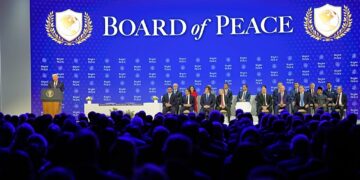
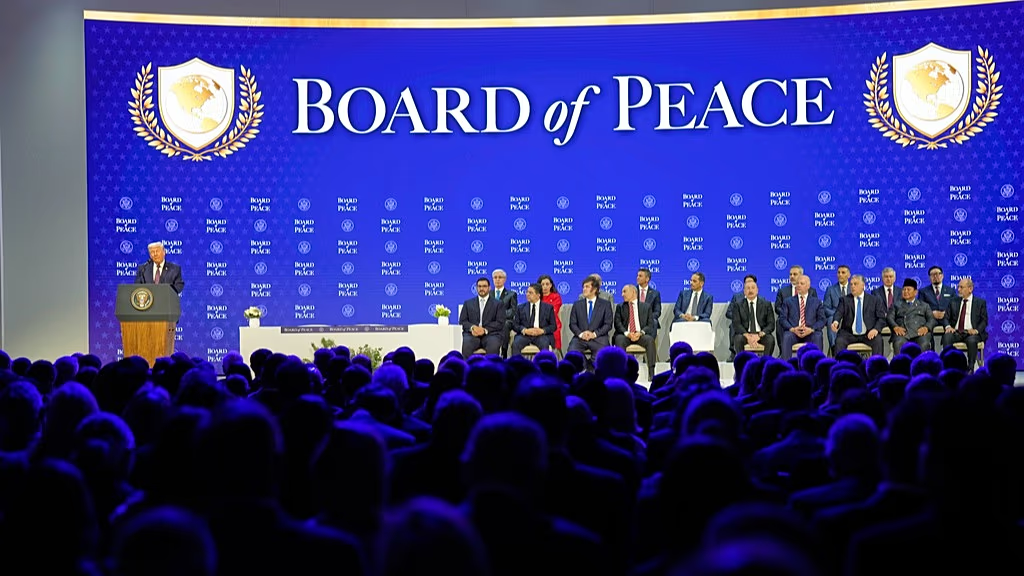
US President Donald Trump on Thursday formally launched his new global peace initiative, the “Board of Peace,” during a signing ceremony at the World Economic Forum (WEF) in Davos, Switzerland, describing the moment as “a very exciting day, long in the making”. “We’re going to have peace in the world. And we’re all stars,” Trump told the audience.
Reflecting on global tensions over the past year, Trump said the world had been “on fire” just 12 months ago but insisted that conditions were now improving. “Many good things are happening,” he said, adding that international threats were “really calming down”.
The president was joined by leaders from founding member states of the board, including Argentine President Javier Milei and Hungarian Prime Minister Viktor Orbán. Trump praised his administration’s foreign policy record, claiming it had helped “settle eight wars,” and said “a lot of progress” had been made toward ending Russia’s war in Ukraine.
He also acknowledged the presence of world leaders at the ceremony, joking that they were “in most cases very popular leaders, some cases not so popular,” before adding: “In this group, I like every single one of them”.
US Secretary of State Marco Rubio described the Board of Peace as “a group of leaders that is about action” and credited Trump with assembling a coalition willing to engage across political divides.
“He’s not limited by some of the things that have happened in the past. He’s willing to talk to or engage with anyone in the interest of peace,” Rubio said.
Rubio added that the board’s immediate priority would be ensuring that the Gaza ceasefire becomes durable, before expanding its focus to other conflicts. However, he acknowledged that many aspects of the board’s structure and operations were still being developed. “Others will join,” Rubio said, noting that some countries were absent due to constitutional or parliamentary approval processes.
Trump has previously described the initiative as potentially the “most prestigious board ever formed.” The idea originated from his 20-point Gaza ceasefire plan, which was endorsed by the UN Security Council, but has since expanded far beyond its initial scope.
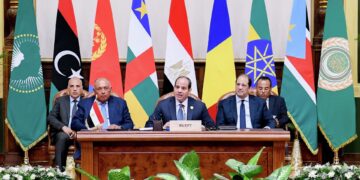
According to US officials, about 35 countries have already committed to joining the board, while invitations were sent to roughly 60 nations. Trump suggested the body could eventually take on functions currently performed by the United Nations, or even make the global institution obsolete. “We have a lot of great people that want to join,” Trump said earlier this week after meeting Egyptian President Abdel-Fattah el-Sisi, whose government has confirmed its participation. Some countries, Trump said, required parliamentary approval before formally committing, while others that were not initially invited had since requested inclusion.
The president also defended his decision to invite Russian President Vladimir Putin, as well as leaders such as Belarusian President Aliaksandr Lukashenka, arguing that he wanted to include “everybody” with the power to “get the job done”.
Several European allies declined to participate. Norway, Sweden and France rejected invitations, with French officials expressing concern that the board could undermine the UN’s role in global conflict resolution, despite backing the Gaza peace plan itself.
Slovenian Prime Minister Robert Golob said the mandate was too broad and risked weakening the international order based on the UN Charter. The UK also declined to sign the treaty at the Davos ceremony, citing objections to Putin’s inclusion, according to British Foreign Secretary Yvette Cooper.
Canada, Ukraine and China have yet to state their positions. Israeli Prime Minister Benjamin Netanyahu agreed to join the board on Wednesday.
According to a copy of the charter obtained by media outlets, countries seeking permanent membership would be required to pay a $1 billion contribution fee, while Trump would remain permanent chairman even after leaving office. Non-paying members would be limited to a three-year term.
The launch of the Board of Peace follows recent tensions with Iran, after Trump threatened military action during violent crackdowns on anti-government protests that reportedly left thousands dead. The president said no further strikes were planned after receiving assurances from Tehran that detained protesters would not be executed.
Trump argued that his hardline approach toward Iran, including airstrikes on nuclear facilities last June, was instrumental in achieving the Israel-Hamas ceasefire, pointing to Iran’s long-standing support for Hamas.
“If we didn’t do that, there was no chance of making peace,” Trump said.
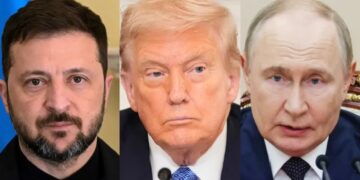
Meanwhile, Ukrainian President Volodymyr Zelenskyy arrived in Davos on Thursday, with Trump expressing frustration over the failure of both Kyiv and Moscow to end the nearly four-year conflict. “I believe they’re at a point now where they can come together and get a deal done. And if they don’t, they’re stupid — that goes for both of them,” Trump said.