

















By Emmanuel Nduka Obisue
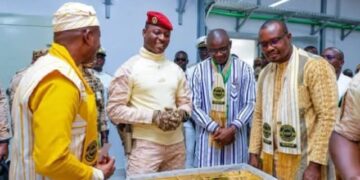
Burkina Faso’s transitional government, led by President Captain Ibrahim Traoré, has ordered major companies operating in the country to establish their headquarters locally, following the adoption of a sweeping decree at a Council of Ministers meeting in Ouagadougou on Thursday.
The directive, approved during the February 12 cabinet session in Ouagadougou, applies to firms with an average annual turnover of at least 5 billion CFA francs (approximately $8.8 million) over the past three fiscal years.
Authorities say the measure forms part of a broader effort to reinforce economic sovereignty, strengthen domestic corporate presence, and stimulate structured urban growth.
Under the new framework, companies will be grouped into four categories based on their revenue levels, with specific construction requirements attached to each band.
Firms in the highest category – those recording annual revenues of 100 billion CFA francs or more, are required to construct headquarters buildings of no fewer than seven storeys (R+7). The structures must include both underground and surface parking facilities and comply with established energy efficiency standards.
Companies in lower revenue brackets will also be mandated to build headquarters ranging between three and five storeys, with corresponding infrastructure provisions tailored to their financial capacity. Officials explained that the tiered approach is intended to ensure proportional compliance while maintaining uniform development standards.
The decree grants affected companies six months to submit detailed architectural and construction plans to a designated government commission for review and approval. Once plans receive clearance, firms will have up to 36 months to complete the projects.
To ease the financial burden, the government announced supportive measures, including exemptions on selected construction materials. Authorities also indicated that serviced land would be made available through the National Urban Land Development Company (SONATUR), enabling companies to secure suitable plots for development.
Government representatives maintain that the policy is designed to deepen corporate roots within Burkina Faso, generate employment in the construction and allied sectors, and improve tax mobilisation by firmly anchoring major economic actors within the national territory.
The legal foundation for the requirement stems from legislation adopted by the transitional legislative assembly in late 2025, forming part of President Traoré’s wider economic reform agenda focused on increasing national control over strategic sectors.
While supporters argue that the move could accelerate infrastructure development and enhance economic resilience, some analysts have cautioned that the new obligations may increase operational costs for foreign investors and could influence perceptions of the country’s business climate.
As implementation begins, attention will turn to how effectively the decree is enforced and how corporate stakeholders adapt to the new regulatory landscape in the months ahead.