






















By Ebi Kesiena
A new report has revealed that an overwhelming majority of Nigerians believe women are capable of leading across critical sectors, even as structural barriers continue to limit their presence in top leadership positions.
This was contained in a communiqué issued after policy and advocacy firm Gatefield hosted a media webinar to present and discuss findings from the 2025–2026 Reykjavík Index for Leadership survey and to commemorate International Women’s Month. The forum brought together stakeholders to examine public perceptions of women in leadership and the policy gaps preventing those perceptions from translating into real opportunities.
According to the report, Nigeria’s overall score on the index rose slightly to 59 out of 100 in 2025, up from 57 recorded in 2024. The increase was largely driven by more progressive attitudes among men, signalling a gradual shift in perceptions of women’s leadership abilities.
The findings show that 89 per cent of Nigerians are comfortable with a woman serving as a chief executive officer, while 77 per cent expressed comfort with a woman occupying the position of head of government. Despite these strong levels of public support, the report noted that women currently occupy only 12 per cent of CEO roles and just four per cent of seats in the National Assembly.
Advocacy Lead at Gatefield, Shirley Ewang, said the gap highlights the disparity between public sentiment and actual representation.
“While most Nigerians are comfortable with a woman leading, women occupy only 12 per cent of CEO roles and four per cent of National Assembly seats. This highlights a stark disparity between comfort levels and actual representation,” she said.
For the first time since Nigeria joined the index, improvements in perception were largely driven by men. While women’s scores remained steady at 61, men’s scores rose from 53 to 56, narrowing the gender perception gap from eight points to five. Analysts noted that the most significant shift came among men aged 45 to 65, a demographic traditionally considered more conservative on gender roles.
However, the report also revealed that belief in workplace equality has declined. The proportion of Nigerians who believe equality has been achieved in the workplace dropped from 62 per cent in 2024 to 55 per cent in 2025, the lowest level recorded in five years.
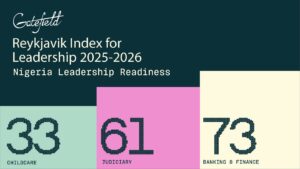
Sectoral analysis shows wide disparities across industries. Banking and finance ranked highest for gender leadership perceptions with a score of 73, followed by education at 72 and pharmaceutical or medical research at 70. At the opposite end, childcare recorded the lowest score at 33, followed by fashion and beauty and engineering, both scoring 46.
The report further noted that perceptions about women in leadership are largely shaped by family and upbringing, cited by 30 per cent of respondents. Education accounted for 18 per cent, personal experience 16 per cent, while media and religion each accounted for nine per cent.
Globally, Nigeria’s score of 59 places it slightly below Germany, which scored 60, and ahead of Kenya at 56. However, the country remains below the G7 average of 68 and far behind global leader Iceland, which recorded a score of 86.
Experts who spoke during the webinar emphasised that while public attitudes toward women in leadership are improving, institutional reforms are required to close the representation gap.
Chief Executive Officer of Caring Africa, Blessing Adesiyan, noted that societal expectations around care work continue to undermine recognition of women as leaders. Similarly, Ekemini Akpakpan of the Women in Successful Careers stressed that stronger institutional support is needed to translate public support into real leadership opportunities.
Other contributors included Rachel Pindar of the Nigerian Governors’ Forum, Omowunmi Akingbohungbe of Women in Management, Business and Public Service, and Itunu Hunga of Women in Leadership Advancement Network, who all called for stronger policy commitments, accountability mechanisms and deliberate efforts to increase women’s representation in leadership roles.
The Reykjavík Index survey for Nigeria sampled 1,082 working-age adults between the ages of 18 and 65, with results statistically weighted to reflect national demographics.