









By Enyichukwu Enemanna
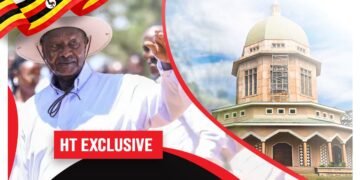
Political watchers have posited that democracy in Uganda has come under intense pressure, where the 81-year-old President Yoweri Museveni who came to power as a rebel leader in 1986 still holds grip four decades later. But irrespective of the avalanche of criticisms he has faced in recent times, arising from his poor handling of dissent, forceful clampdown on opposition voices, as well as compromise of the independence of state institutions, he is still remembered for the role he played during his country’s struggle for independence from the United Kingdom. Most importantly, Museveni was a key figure that campaigned for Uganda’s liberation at a time of brutality and turbulence under former leaders, Milton Obote and the notorious Idi Amin. These memories still linger especially among the generations old enough at that time to witness the sweat and blood that went into the struggle. However, the clear drift from a pro-people figure to a sit-tight dictator, whose family members wield undue influence in state affairs has overtime dwarfed the goodwill he once enjoyed. These excesses have slipped, others growing hydra-headed amid deafening silence of regional bodies, including the African Union who ordinarily should serve as protectors of democracy rather than punishers of coup.
Museveni for several years knew little about his actual date of birth. In fact, at the time of writing his memoir, he was quoted as saying, “We had real life-threatening challenges such as extra-judicial killings and looting… we had no time to worry about details such as dates of birth”. In 1967, he travelled to the neighbouring Tanzania and attended the University of Dar es Salaam in the capital where he studied economics and political science.
During this period, Museveni formed alliances with politically active students from around the region. Few years later, particularly in the 1970s, his name gained prominence after a coup by the notorious Amin, under whose watch an estimated 400,000 people were extra-judicially executed in his 8-year iron fist rule. Amin was also infamous for crushing opposing voices and expelling the country’s Asian community. Museveni’s alliance, the Front for National Salvation, one of the rebel groups then with the assistance of Tanzania ended Amin’s oppressive regime and sent him packing.
After Amin’s fall, former President Milton Obote returned to power via a general election. Museveni however rejected Obote, refusing to accord his leadership recognition, alleging that the election that brought him to power was rigged. On the account of this, he launched a guerrilla warfare in 1981 and five years later, his rebel group, the National Resistance Movement (NRM), seized power and Museveni became the leader.
When The Ovation Was Loudest
Museveni steered Uganda to reconstruction and stability after years of conflict under Amin and Obote. The early days of his government focused on rebuilding state authority and integrating rebel groups into the mainstream military system, achieving key economic milestones, which created a sense of predictable governance after years of anarchy. Before Museveni took over power, Uganda was ravaged by inflation, infrastructure collapse, and capital flight. But these were reversed by policies that targeted economic liberalisation structural reforms, currency stabilisation and reduced hyperinflation. Uganda was at that time used as a reference point by international financial institutions as a model of post-conflict economic recovery in Africa. There was unprecedented growth in agricultural exports, especially coffee, Uganda experienced increased foreign investment and donor support as well as strong GDP growth in the early 1990s.
Health facilities started working again, schools were reopened, roads and public infrastructure were rebuilt while the civil service and tax system were revived. Uganda’s economy began to grow steadily and over 10 years, the country saw an average annual growth of more than 6%. Primary school enrolment significantly increased and HIV levels dropped, arising from anti-AIDS campaign spearheaded by the administration. Literacy and social indicators gradually began to pick up.
Ugandans were proud of the leadership they had in Museveni but unfortunately, things took a new twist and political system became increasingly centralised around him. He became stronger and more influential than the state institutions. He whittled down their independence, a situation that saw tongues wagging. Confidence was lost in the electoral system as transparency and fairness came under question. The legislature and judiciary became heavily arm-twisted. Opposition parties faced hostile restrictions and unfavourable policies.
2005 Removal of Tenure and 2017 Deletion of Age Limits
Museveni undermined his country’s 2005 Constitution which allows for a maximum of two-term of five years each by seeking tenure extension. This is against the more honourable option of taking his exit while the ovation was at its loudest. When he was approaching the end of his second elected term in 2006, he surreptitiously initiated an amendment to the constitution to get a legal backing to remain in office.
He secured a majority in the parliament and in July 2005, there was an amendment to the constitution and the two-term presidential cap was expunged, allowing him to remain office as long as he wishes. There were also reports of inducement and intimidation of members of the parliament but the government expectedly denied any wrongdoing.
His 2006 electoral victory was seen as an affront to the spirit of the 2005 Constitution as it largely weakened democratic safeguards and entrenched personal rule as against the Rule of Law. In 2017, Museveni also orchestrated another amendment to the Constitution but this time, on age limit so that he would not be constitutionally barred to seek a fresh election as he was approaching the 75 years threshold. Again, this received parliamentary nod and in 2021, he contested and won, setting another negative precedent for altering the constitution at the whims and caprices of the incumbent.
Consolidation of Power, Son on the Loose
Museveni has also been criticised over the manner he has made attempts to consolidate power within his family cycle, sparking nepotism debate in the administration in its 4th decade. Analysts believe that this move is targeted around his succession plan when his tenure expires in 2031. Members of his family are holding influential positions around the education, security and defence sectors. For instance, his wife, Janet Museveni has played a long-standing cabinet role as the Minister of Education and Sports while his brother, a long-time military figure, Salim Saleh is occupying the position of the Senior Presidential Adviser on Defence and Security, an influential position linked to military and security policy.
Most prominent is his son, Muhoozi Kainerugaba who serves as head of Uganda’s military in his capacity as the Chief of Defence Forces. A former commander of the Land Forces, his accelerated promotion to the rank of CDF as well as his deep involvement in politics has raised suspicion that he is being groomed as his father’s possible successor.
He is popular for making unbridled and provocative comments especially on social media, where he in 2022 threatened to invade and capture Nairobi, causing a diplomatic friction between Uganda and Kenya. Authorities had to distance themselves from the threat following a backlash, which was followed by public apologies from his father, Museveni. Not long ago, he also made inflammatory remarks on the military operations in Democratic Republic of Congo, stirring tension with Kinshasa and other actors in the region.
Kainerugaba, 51 has joined forces with his father to stifle opposition in the country and make the civil space even more toxic and hostile, undermining basic principles of liberty and freedom which democracy offers citizens. Under Museveni and his son’s watch, dictatorship is gradually displacing Rule of Law, especially with the way opposition figures and dissenting voices are being hounded and imprisoned under a compromised judiciary.
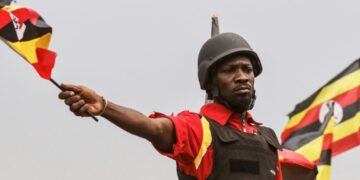
Before the presidential election last month, Kainerugaba had launched a clampdown on leader of the National Unity Platform (NUP), Bobi Wine, whose real name is Robert Kyagulanyi, incarcerating his supporters, using security forces to disrupt opposition-backed rallies. He had also threatened to behead the opposition leader among other controversial comments, creating atmosphere of fear and tension in the minds of voting Uganda’s citizens.
Even after the opposition lost the election in questionable circumstances, Kainerugaba, using the instrumentality of the state has continued to haunt Bobi Wine and his followers. Last month, he confirmed the killing of at least 30 “terrorists” in a veiled reference to opposition supporters while 2000 others were arrested and detained in unconventional facilities where they are believed to face torture. He went further to pointedly declare that Bobi Wine will join in the number of those killed.
Kainerugaba had also issued Bobi Wine, 43, who went into hiding in view of these credible threats a 48-hour ultimatum to surrender or be treated like a rebel. The President’s son has also unilaterally placed a ban on Bobi Wine from contesting in future elections in view of what he said is in national interest. His exact word – “Whether Robert Kyagulanyi Ssentamu is in the country or not, I, as CDF, in the interests of national security and for the good of the commonwealth, ban him from any further participation in the electoral exercises of Uganda.”
Institutional Weakness of AU
While the African Union is usually in a haste to suspend any member nation in matter of hours after each military coup, same energy has not been deployed to ensure that enablers of military incursions are largely mitigated and prevent coups from happening, rather than issuing suspensions that barely have effects. Again, the sovereignty of every nation and non-interference with internal affairs remain undisputed but failure of the pan-African body to adopt diplomatic approaches, including behind-the-scene honest conversations sends the wrong signal to intending emperors in government houses that bad behaviours have no consequences.
Regional bodies shape good governance and citizens’ expectations and serve as custodians of constitutional order, but where leaders are meant to believe that consequences are unlikely, the call for military takeover as seen in parts of the continent become imminent, which indeed serves the continent no good. The body language from the AU to Uganda at the moment speaks to international abandonment which fuels the temptation to resort to self-help, anarchy and unrest.