















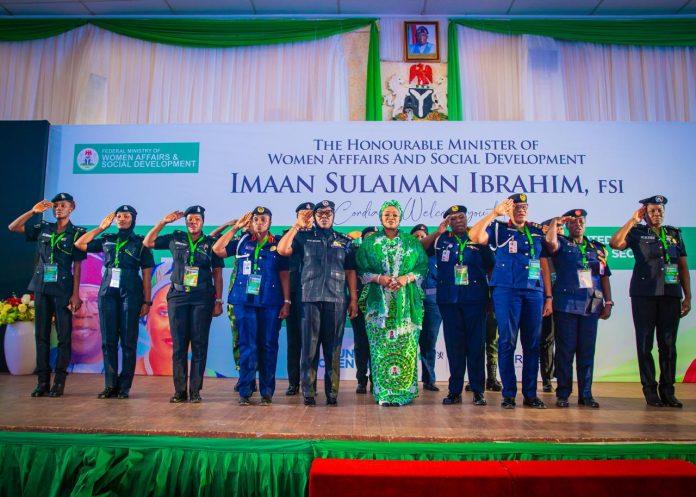
By Ebi Kesiena
The Nigerian Government has inaugurated the country’s third National Action Plan (NAP III) for the implementation of the United Nations Security Council Resolution (UNSCR) 1325 on Women, Peace and Security, reaffirming the country’s commitment to inclusion, gender equality and sustainable peace.
The action plan, which covers the period 2025–2030, was inaugurated in Abuja by the First Lady, Senator Oluremi Tinubu on Monday
Represented by the wife of the Deputy Senate President, Laila Barau, Mrs Tinubu said women remain indispensable actors in peacebuilding efforts across the world.
She noted that 25 years ago, UNSCR 1325 marked a turning point by recognising that women should no longer be sidelined but actively involved in shaping peace and security. According to her, Nigeria embraced this global vision through its first and second national action plans and is now advancing the agenda with the launch of NAP III, guided by President Bola Tinubu’s Renewed Hope Agenda, which prioritises inclusion, stability and collective progress.
While acknowledging progress made so far, the First Lady stressed that women and girls in insecurity-affected communities continue to face significant challenges. She said Nigerian women have consistently shown resilience by mediating conflicts, rebuilding communities and sustaining families in difficult circumstances, underscoring the need to keep the women, peace and security agenda at the forefront of national priorities.
She called on all stakeholders, particularly state governments, to implement the action plan with urgency and commitment. She also urged security agencies to deepen gender-sensitive reforms, appealed to traditional and religious leaders to protect women and children, and encouraged men and boys to partner in building a just and equitable society.
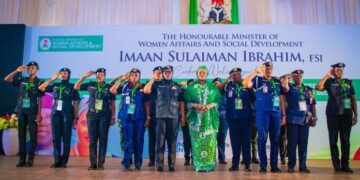
Speaking earlier, Minister of Women’s Affairs, Imaan Ibrahim-Sulaiman, said Nigeria domesticated UNSCR 1325 following its global adoption in 2000, launching the first National Action Plan in 2013 and consolidating gains with the second in 2017.
She explained that NAP III, approved by President Tinubu, aligns national efforts with current global realities and firmly anchors them within the Renewed Hope Agenda, placing women, children, families and vulnerable groups at the centre of national stability, inclusive governance and sustainable peace.
Meanwhile, UN Women Representative to Nigeria and ECOWAS, Ms Beatrice Eyong, represented by UNICEF Country Representative Wafaa Saeed Abdelatef, described the launch as timely, noting that 2025 marks 25 years of UNSCR 1325 and 30 years of the Beijing Platform for Action. She stressed that the success of NAP III would depend on adequate funding, strong political will and effective implementation across all states.
Explaining the framework of the plan, UN Women Programme Manager on Women, Peace and Security, Mr Peter Mancha, said NAP III is built on five pillars, prevention and disaster preparedness; participation and representation, protection and prosecution, crisis management, early recovery and post-conflict reconstruction; and partnership coordination and management.
He explained that the third action plan was developed to address challenges encountered in the first two NAPs, including limited awareness, weak political will, inadequate funding and poor coordination. According to him, the Federal Ministry of Women’s Affairs adopted a multi-sectoral and participatory approach involving all six geopolitical zones, legislators and key institutions.
Mancha said NAP III is uniquely endorsed by the President, the National Assembly and the leadership of security institutions, including the Chief of Defence Staff and the Inspector-General of Police, signalling stronger ownership and commitment to ensuring its objectives are fully implemented and sustained by both the government and the people of Nigeria.