





















By Lara Raji
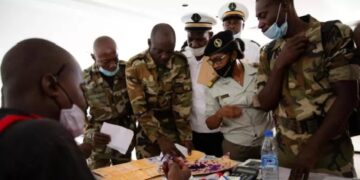
On December 4 2025, the National Peace Committee, in partnership with the European Union
Delegation to Nigeria and ECOWAS, convened a peace dialogue that brought together
government officials, faith leaders, academics, and civil society actors. The diversity of
participants was not unusual for Nigeria. The shared consensus by all participants was that
lasting stability must be built from within. External partners can assist, but sustainable peace
depends on accountable domestic institutions, legitimate local leadership, and community
ownership.
In 2013, during the fiftieth anniversary of the Organisation of African Unity, now the African
Union, African leaders committed to a bold goal: “Our determination to achieve the goal of a
conflict-free Africa … and undertake to end all wars in Africa by 2020.” More than a decade later, that
vision remains aspirational. Several countries in Africa, including Nigeria, continue to grapple
with protracted violence, mass displacement, and destruction of lives and properties. Nigeria’s
Northeast, Northwest and Middle Belt regions are experiencing recurring conflict shaped by
political, social, religious, and economic dynamics. Other regions of the country experience
low-level communal violence, with significant impact on lives and property.
There have been significant interests by the international community and development partners
to invest in peacebuilding in Nigeria. Recent remarks by Donald Trump, President of United
States, alleging a genocide against christians has also shown the significant external interest and
influence in Nigeria’s conflict and peace dynamics. The temptation to outsource peace is
powerful, given the complex nature of conflicts and the deep governance challenges in Nigeria.
But as Bishop Matthew Kukah once remarked, “Our peace should not be outsourced.” And it
cannot be outsourced. This position gently reminds us that external partners can offer support,
but lasting stability depends on government institutions, religious bodies, and communities
taking responsibility for initiating and sustaining the work of peace. Local knowledge,
legitimacy, and accountability remain the foundations that others can complement but not
replace. And once we accept that peace must be built from within, the question becomes: who
shapes the internal moral compass of communities?
Morality in conflict is not abstract; it is lived, communicated, and shaped by those with social
authority. In Nigeria, religious leaders have enormous influence and often occupy that role:
their messages, silences, and interpretive choices shape how their followers understand justice,
restraint, forgiveness, compassion, and even vengeance. At the heart of responsible religious
leadership are two commitments: interpretive discipline and moral courage. Interpretive
discipline means reading texts in their context, and the scripture’s intent — the “minus five, plus
five” rule (an encouragement to look at the five verses before and after any quoted passage for
context) is a simple safeguard against cherry-picking scripture to justify violence.
Moral courage means challenging followers and political powers when necessary. Without both,
religious influence can shield perpetrators and legitimise harm. Sheikh Nurudeen Lemu
emphasised a critical principle: moral standing is essential not only for religious leaders but also
for those who claim to represent the goodness of God’s will on earth and for all humanity. Such
moral authority requires compassion that extends beyond one’s own faith or community,
ensuring that justice and care are universal rather than selective.
Leadership is not a popularity exercise; it demands the moral resolve to confront harmful
behaviour, even when doing so is costly. This resolve is often weakened in environments where
authority is tied to political patronage or the approval of followers. In its absence, religious
authority can become a protective canopy for offenders, enabling violence to be rationalised as
the defence of identity, tradition, or doctrine. History provides sobering lessons globally:
debates around liberation theology in Latin America revealed how religious authority could
justify political violence. At the same time, contestations over just war theory in Christianity
and Islam highlight the dangers of interpreting sacred texts without proper context. In Sheikh
Nuruddeen Lemu’s words, “Text without context becomes pretext,” reminding us that sacred
writings, when misapplied, can become instruments of harm rather than guidance.
Based on this discourse, it is clear that moral courage alone is not enough; religious leadership
should be equipped to sustain peace, provide counselling, and help detect early signs of
extremist tendencies amongst followers before they take hold. According to Sheik Lemu,
“Extremism rarely announces itself; it is like a chameleon, often infiltrating under the guise of
piety, seeking legitimacy and influence before taking root and causing harm”. These simple
safeguards. He also emphasises the “minus five, plus five” can help prevent misinterpretation
and the misuse of scripture, steer listeners away from manipulation or violence, and foster a
culture of peace, understanding, and resilience.
Beyond religious dynamics, the dialogue highlighted key structural drivers of conflict in
Nigeria, including but not limited to poverty, weak local governance, unreliable data, social
media, and displacement. Poverty remains a persistent trigger, as economic desperation lowers
the threshold for recruitment into armed groups and intensifies competition over scarce
resources. Weak local governance further compounds insecurity by eroding trust, weakening
dispute-resolution mechanisms, and creating vacuums that violent actors quickly fill. Equally
critical is the absence of reliable data, with Nigeria’s last census in 2006, leaving nearly two
decades of demographic and displacement trends unaccounted for; without such information,
policymakers cannot anticipate pressures or design interventions early enough to prevent
escalation. Displacement itself reshapes local social landscapes by straining host communities,
disrupting livelihoods, and creating new layers of competition and mistrust that often go
undetected until tensions erupt. Addressing structural drivers is the responsibility of
government and institutional actors, who are best positioned to implement policies, provide
services, and create systems that complement their efforts.
Within the framework of conflict prevention, women play a critical, though often
under-recognised, role in early warning systems. As Barrister Aisha Ado Abdullahi observes,
women are frequently the first to notice subtle shifts in community dynamics; changes in
relationships, emerging tensions within local networks, or early signs of mistrust that formal
institutions often overlook. This heightened awareness stems from the everyday roles women
occupy, which connect them to multiple layers of social life and information flows. Failing to
leverage this insight represents a missed opportunity to make conflict-prevention strategies
more precise, responsive, and grounded in communities’ lived realities.
Sustainable peace in Nigeria requires a whole-of-society approach that links structural reform
with everyday moral leadership. The conversations at the National Peace Dialogue all pointed
to the fact that sustainable peace grows from within. When local institutions, leaders, and
communities take responsibility, external support becomes meaningful, then Nigeria gains its
strongest footing for lasting peace.
Lara Raji is the Head of Programmes, Conflict Research Network West Africa (CORN West
Africa).