




By Emmanuel Nduka
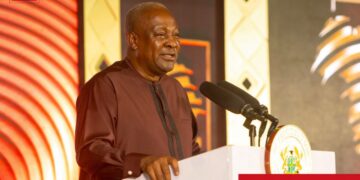
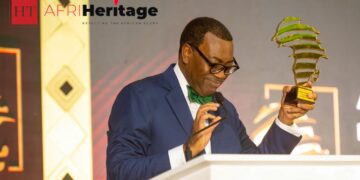
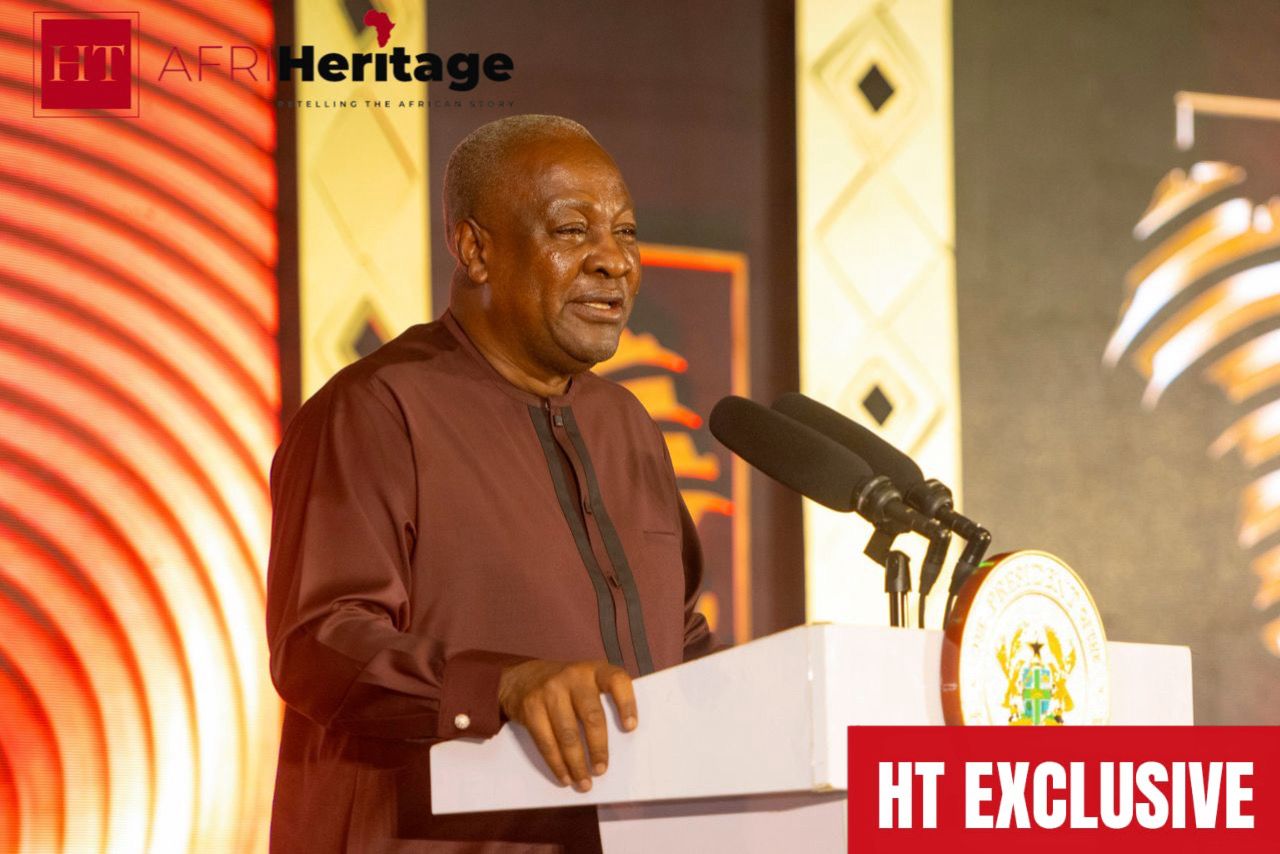
At the 4th African Heritage Awards held in Accra, Ghana, just recently on April 11, President John Mahama delivered a speech that oscillated between humour and hard-edged realism. For those who paid keen attention, there was a deeply consequential message about Africa’s future, Nigeria’s centrality, and the urgency of economic self-determination beneath the light moments.
Here are six defining talking points that shaped the address:
1. Nigeria As Ghana’s Strategic Lifeline, An Existential Concern
President Mahama did not mince words in underscoring Nigeria’s outsized influence as a neighbour and as a stabilizing (or destabilizing) force in West Africa.
“Ghana and Nigeria are twins of the same mother, except when we fight over Jollof and football. Otherwise, you know we are the same people,” Mahama said.
He went further, tying Ghana’s security outlook directly to Nigeria’s fortunes. “A lot of the people in Ghana migrated from Nigeria. They find their roots in the Yoruba kingdoms and all that… and so, Nigeria is of keen security interest to us”.
The message was unmistakable. Nigeria’s trajectory is not a domestic affair. It is a regional determinant with real demographic, economic, and security implications.
2. A Stark Warning Wrapped In Prayer For Nigeria
Perhaps the most striking and controversial moment of the night came when Mahama framed Nigeria’s struggles in both spiritual and pragmatic terms. “If Nigeria does well, Ghana does well,” he said. “I mean, when you have cousins, 250 million of them, you want them to do well so that 1 million of them don’t come drifting towards a small country like Ghana,” he added.
Then came the line that has since dominated headlines. “So every day I wake up, I pray for Nigeria, I say God let Nigeria get their act together”. Behind the humour lies a blunt geopolitical reality that Nigeria’s instability carries spillover risks that smaller neighbours cannot absorb indefinitely.
3. The Collapse Of Old Global Promises, And Africa’s Urgent Reckoning
Speaking further, President Mahama then shifted from regional commentary to a sweeping critique of the global order, arguing that Africa must urgently rethink its assumptions about international cooperation.
“We need to make a paradigm shift in how we have considered investments, how we’ve considered our natural resources and everything in Africa”. “The world is changing, the global order is changing, and we must adapt to the changes. After the Second World War, we all agreed that we had a multilateral system and each was his brother’s keeper,” he added, tracing the arc from post-war optimism to present-day disillusionment.
But that promise, he argued, has eroded. “After the arms race came to an end, we said there was going to be a dividend, a nuclear dividend which would make sure that everybody on this earth enjoys a decent standard of living. I mean, clearly, things are shifting from what we all anticipated. Humanitarian assistance is dwindling, countries are reducing their ODA and using it more for defence purposes and all that”.
The implication is stark. Africa must prepare for a world where external support is no longer reliable.
4. End Of The Era Of Extractive Deals And ‘Enclaves Of Wealth’
In one of the speech’s most forceful passages, Mahama attacked the long-standing model of foreign exploitation of Africa’s natural resources.
“Africa cannot sit with a cup in hand and go begging. One of the major assets we have is what nature gave us. We didn’t put the gold in the ground, we didn’t put the lithium in the ground, we didn’t put the oil and gas in the ground,” he challenged.
He framed resource wealth as both a divine endowment and a political responsibility. “God gave it to us, and so like I’ve said in many places, those days of huge concessions gifted to foreign companies and set up huge you know rich enclaves next to African poverty where there’s no clean drinking water, those days are coming to an end”.
This was less a policy suggestion than a declaration that the status quo is no longer tenable.
5. AfCFTA, Leadership, And Africa’s Untapped Intellectual Power
Despite the heavy critique, at least President Mahama ended on a cautiously optimistic note, pointing to structural initiatives and human capital as Africa’s path forward.
“We must take advantage of what God has gifted us to make sure that we’re able to create prosperity for our people, and we can do it,” he advised.
He highlighted the promise of the African Continental Free Trade Area. “We started with the African continental free trade area, we do have teething problems, but I’m sure that it’s a good sign. Already, we can see that trade between our countries is increasing, and so we do have the capacity to be able to create prosperity for our people and dignity”.
Ultimately, he placed the burden and opportunity squarely on leadership. “We continue to fight and represent our countries. We want to show that leadership can make a change because I believe that if we get proper leadership in Africa and we work together, we have some of the best brains, we have wonderful people, we’ll be able to make a change in the lives of our people”.
6. Presidential Endorsement, And Testimony To AFRIHeritage Award’s Credibility
Beyond policy and geopolitics, President Mahama used a deeply personal reflection to validate the integrity and non-partisan credibility of the African Heritage Awards, framing it as an institution willing to defy political convenience.
“I want to thank Moses and his team for continuing to host these awards in the face of challenges, and I can just say for myself that at the time Moses recognized me and gave me that award in 2024, I was not president of Ghana. I was a leader of the opposition, and I was running for government. It takes courage to decide that you’re going to award a leader of an opposition party in an African country. Moses, thank you so much! I got the award in 2024 when I was an opposition leader, not when I was president, and so it makes me believe that your system for recognising people is not based on any parties and consideration. So thank you very much, I hear you’ve going to Cape Town next year, and if it’s possible, we’ll probably all come in and join you”.
In a political environment where recognition is often tied to incumbency and influence, Mahama’s account served as endorsement, suggesting that credibility in African institutions must be built on courage, independence, and a willingness to recognize merit beyond power.