
















By John Ikani
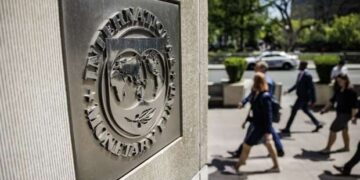
Nigeria’s economic growth is expected to slow down from 3.3 percent in 2022 to 2.9 percent in 2023, according to the International Monetary Fund (IMF).
This projection was disclosed in the IMF’s “World Economic Outlook: Navigating Global Divergences,” released on Tuesday.
The IMF also anticipates a growth rate of 3.1 percent for Nigeria in 2024, with the adverse impact of high inflation on consumption becoming more evident.
“The forecast for 2023 is revised downward by 0.3 percentage point, reflecting weaker oil and gas production than expected, partially as a result of maintenance work,” the report stated.
Global headline inflation is expected to gradually decrease from its peak of 8.7 percent in 2022 (annual average) to 6.9 percent in 2023 and 5.8 percent in 2024.
The forecast for 2024 has been adjusted upward by 0.6 percentage points, driven by higher-than-expected core inflation.
“On a year-over-year basis, projected global headline inflation peaked at 9.5 percent in the third quarter of 2022 and is projected to reach 5.9 percent by the fourth quarter of 2023 before falling to 4.8 percent in the fourth quarter of 2024, still above the pre-pandemic (2017–19) annual average of about 3.5 percent,” the report highlighted.
While the IMF acknowledged that monetary tightening is beginning to yield results, a significant factor contributing to the expected decline in headline inflation in 2023 is the decrease in international commodity prices.
The IMF noted that nearly three-quarters of economies are expected to experience lower headline inflation in 2023, with advanced economies projected to see a more substantial decline of 2.7 percentage points, compared to 1.3 percentage points in emerging markets and developing economies.
This disparity is attributed to advanced economies’ stronger monetary policy frameworks and communications, as well as their lower exposure to commodity price and exchange rate shocks.
In low-income developing countries, inflation is projected to remain in double digits on average and is not expected to decrease until 2024.
The report also highlighted significant variations in the expected pace of change in headline inflation across major economies, influenced by different starting points.
The euro area, for instance, is expected to witness a sharp decline in year-over-year inflation in 2023, dropping by 6.6 percentage points from 9.9 percent in the fourth quarter of 2022 to 3.3 percent in the fourth quarter of 2023, partly due to the decrease in energy prices.
Background:
In April, the IMF had maintained its growth forecast for Nigeria’s economy in 2023 at 3.2 percent.
However, the IMF noted that early signs of a soft landing for the global economy with decreasing inflation and steady growth in 2023 had faded due to persistently high inflation and recent financial sector turbulence.
President Bola Tinubu, during his May 29 inauguration, announced the removal of petrol subsidies, leading to increased hardship for many Nigerians and a rise in the prices of goods and services.
In addition, the Central Bank of Nigeria (CBN) unified all segments of the foreign exchange (FX) market to enhance transparency and investor confidence, a policy widely praised but which also exerted pressure on the local currency and manufacturers, resulting in price effects.
Inflation has remained elevated in Nigeria, prompting the CBN to raise interest rates to their highest levels in nearly two decades in July.
The central bank stated that the rate hike had a significant impact on moderating inflation and suggested that continuing this policy could be considered, given expected liquidity injections into the economy from recent efforts to unify the nation’s foreign exchange markets.
Furthermore, Nigeria has grappled with revenue challenges, pipeline vandalism, and crude oil theft in its oil-producing region in recent years, contributing to its economic challenges.