


















By Emmanuel Nduka
From feeding 25 pupils as a student to transforming school meals for hundreds of thousands of children, Wawira Njiru’s extraordinary journey has earned her the prestigious German Africa Prize.
What began as a modest dream by a young Kenyan student to ensure that children had at least one nutritious meal a day has grown into one of Africa’s most remarkable social-impact initiatives, reaching more than 660,000 schoolchildren across the country.
At the centre of that transformation is Wawira Njiru, the 35-year-old Founder of Food4Education (F4E), a social enterprise that has revolutionized the way school meals are delivered in Kenya while simultaneously creating a dependable market for small-scale farmers.
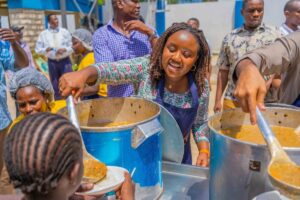
Njiru’s remarkable work has now earned her the German Africa Prize, awarded by the German Africa Foundation in recognition of individuals whose ideas and achievements offer solutions to major challenges facing Africa and the wider world.
Her journey began on a much smaller scale. As a student, Njiru started providing regular meals to just 25 schoolchildren, driven by a simple ambition to expand the programme and eventually feed 100 children every day.
More than a decade later, that modest initiative has become a nationwide operation. Food4Education now provides meals to over 660,000 children in more than 1,900 schools across Kenya, supported by a workforce of about 6,000 people.

For many of the children reached by the programme, the meal served at school is not simply a supplement to what they eat at home. It can be the main meal they receive during the day.
The German Africa Foundation said Njiru had succeeded in transforming what was once regarded largely as charitable assistance into a sustainable system that benefits children, families, farmers and the wider economy.
Claus Stäcker, chair of the independent Africa Prize jury and director of programmes for Africa at Deutsche Welle, described the Food4Education model as “an African solution to a global problem”.
He said Njiru had transformed a charitable idea into a functioning school-feeding system that reaches children, engages families and strengthens local economic cycles.
The programme’s impact goes beyond the classroom. About 80 per cent of the food distributed by Food4Education comes from small-scale farmers, giving local producers a reliable market for their agricultural products while ensuring that schoolchildren receive freshly sourced food.
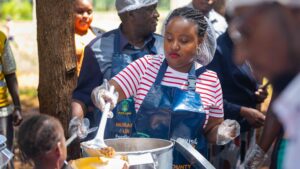
The approach challenges the traditional perception of school feeding as simply an act of charity.
“For a long time, school meals were viewed as charity. We’ve proven that it’s economic infrastructure,” Njiru told DW.
That philosophy has become central to the organisation’s model, linking the fight against child hunger with agricultural development and local economic empowerment.
Njiru herself describes her determination in remarkably simple terms.
“I’m stubborn. Once I figure I want something, I try and work towards it. And, you know, it’s hard to tell me something is not possible,” she said.
That persistence has helped turn an idea that started with 25 children into a programme serving hundreds of thousands.
Reacting to the German Africa Prize, Njiru described the recognition as an “incredible honor” for herself and the entire Food4Education team.
She particularly acknowledged the thousands of employees who work daily to ensure that children are fed.
The organisation has also grown beyond providing meals. It now assists other governments with planning and developing school-feeding programmes adapted to their own circumstances, further extending the reach of Njiru’s vision.
The German Africa Foundation, a nonpartisan organisation established to promote a nuanced understanding of Africa in German political circles and among the German public, has presented the German Africa Prize since 1993.
The award recognises outstanding individuals from African countries whose ideas and work inspire solutions to global challenges and have relevance beyond their own countries.
Njiru joins a distinguished list of African recipients, with previous winners including prominent figures from Zimbabwe, Cameroon and Sierra Leone.
Germany’s Minister for Economic Cooperation and Development, Reem Alabali Radovan, is scheduled to present the award to Njiru on November 4 at the Allianz Forum in Berlin.
From 25 children to more than 660,000, Njiru’s story is ultimately one of how an audacious idea, sustained by determination and innovation, can grow into a powerful force for social and economic change.
Her work demonstrates that feeding a child can be much more than providing a meal. It can support education, strengthen families, create markets for farmers and build economic infrastructure capable of transforming communities.