

















By Ebi Kesiena
Political Stakeholders have called for stronger political party structures, internal discipline, transparency and sustained anti-corruption reforms ahead of the 2027 general elections, warning that credible elections depend on strong institutions and accountable leadership.
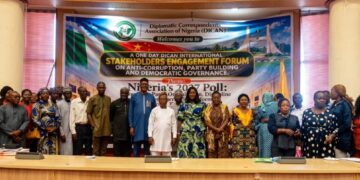
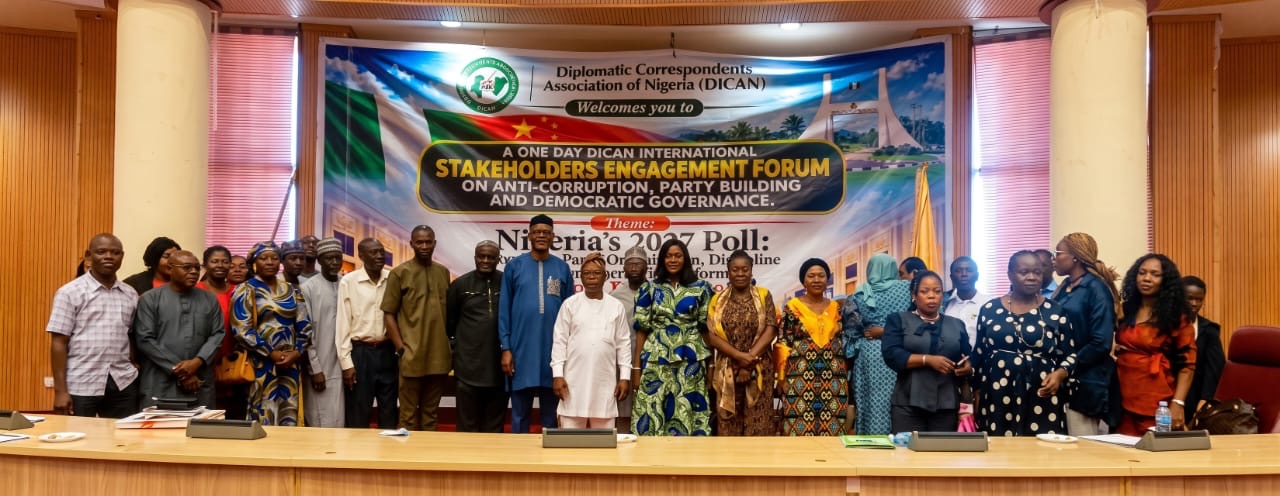
The call was made on Wednesday at a during a one-day International Stakeholders Engagement Forum on Anti-Corruption, Party Building and Democratic Governance, organised by the Diplomatic Correspondents Association of Nigeria (DICAN).
With the theme, “Nigeria’s 2027 Poll: Promoting Party Organisation, Discipline and Anti-Corruption Reforms – Lessons from Xi Jinping’s Thoughts,” diplomats, government officials, political actors, academics, civil society organisations, development partners and journalists converged to examine strategies for strengthening democratic governance.
Speaking DICAN Chairman, Idehai Frederick said the engagement was timely as Nigeria prepares for the 2027 general elections, noting that the credibility of democracy depends on the strength of political institutions, internal party discipline, transparency, integrity and respect for the rule of law.
He explained that democracy went beyond the conduct of periodic elections, stressing that it required strong institutions, accountable leadership and political parties guided by clear principles and internal democratic processes.
“Democracy is more than the conduct of periodic elections. It thrives when institutions are strong, when political parties operate based on clear principles and internal discipline, when public officials are accountable to the people, and when governance is guided by transparency, integrity, fairness and the rule of law,” he said.
Idehai noted that the forum was organised to encourage constructive engagement and practical recommendations that would strengthen political party organisation, improve accountability and advance anti-corruption reforms.
He clarified that the reference to China’s experience was not an attempt to promote the adoption of another country’s political system but to examine international practices that could offer useful lessons within Nigeria’s constitutional and democratic framework.
He reaffirmed Nigeria’s commitment to its multi-party democratic system, where political competition, electoral choice, citizens’ participation and the rule of law remain fundamental principles.
Also, representing the Minister of State for Foreign Affairs, Ambassador Sola Enikanolaiye, the Assistant Director of Administration at the Ministry, Muhammed Aliyu, commended DICAN for its contributions to promoting Nigeria’s foreign policy objectives through diplomatic reporting and fostering cordial relations with other countries.
Aliyu described anti-corruption and party building as essential pillars of democratic governance, explaining that both were critical to strengthening institutions, promoting transparency, ensuring accountability and restoring public confidence.
He said democratic governance must extend beyond elections to include the protection of fundamental freedoms, institutional checks and balances and effective service delivery.
Linking the forum’s discussions to Nigeria’s four-D foreign policy priorities of Demography, Development, Democracy and Diaspora, he urged political parties, the media, civil society organisations and government institutions to work collectively towards achieving the objectives.
He expressed hope that the engagement would generate recommendations capable of strengthening democratic institutions and improving the delivery of democratic dividends to Nigerians.
In her remarks, Counsellor Dong Hairong, representing the Embassy of the People’s Republic of China in Nigeria highlighted China’s experience in party discipline and anti-corruption, particularly the Communist Party of China’s commitment to rigorous internal governance.
She disclosed that China had recorded 8.1 million corruption cases since 2012, with more than 7.9 million officials subjected to disciplinary and administrative penalties, including over 900 officials at vice-ministerial level and above.
The representative reaffirmed China’s determination to sustain its anti-corruption campaign, declaring that the fight against corruption would be pursued to the end.
Furthermore, political analyst, Dr. Charles Onunaiju, said Nigeria’s democratic development required more than improvements in electoral technology and administration, stressing the need to transform political parties into ideological, disciplined, organised and accountable institutions.
He identified weak internal democracy, monetisation of elections and poor party discipline as major obstacles to democratic consolidation.
Onunaiju noted that Nigeria could draw useful lessons from China’s experience in party organisation and anti-corruption without necessarily adopting its political system.
“The 2027 elections will require more than improvement in electoral technology and administration. Sustainable democratic progress depends on transforming political parties into ideological, organised, disciplined and accountable, people-centred institutions,” he said.