




By Enyichukwu Enemanna
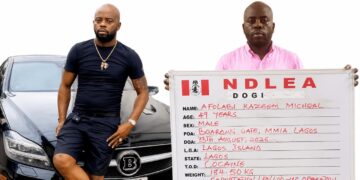
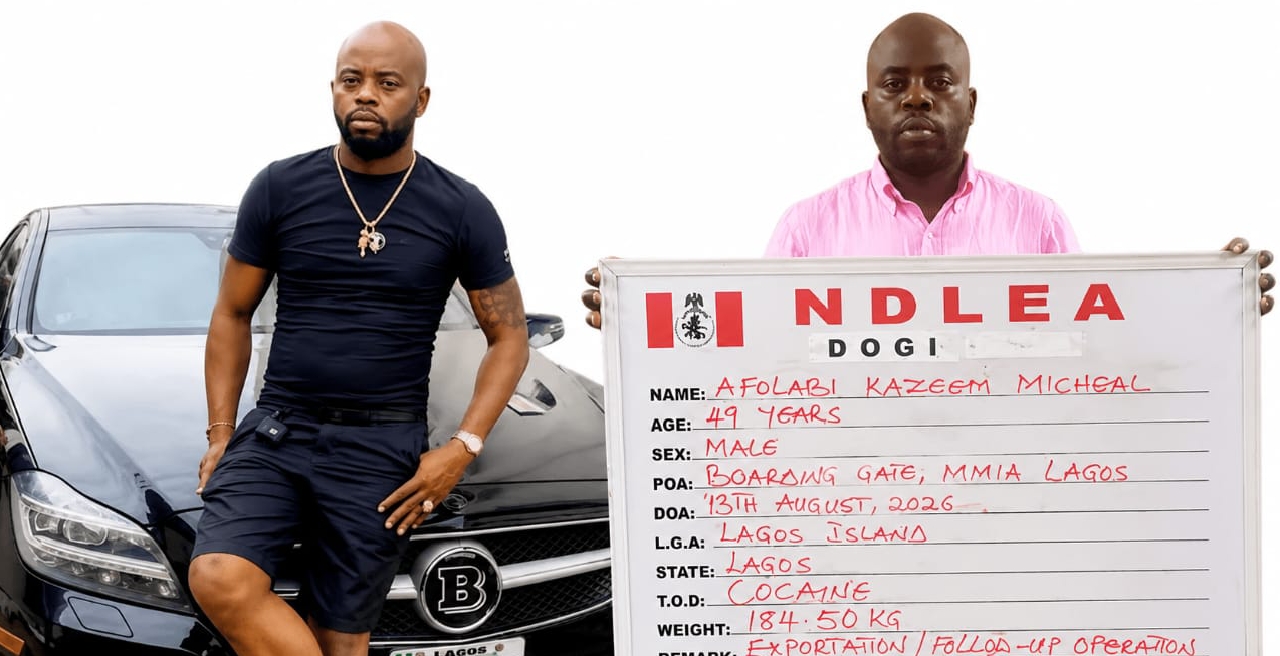
With an online persona centred around affluence, financial success and high-value jewellery, Afolabi Kazeem Micheal, popularly known as “KC Luxury” is known to his 7000,000 Instagram followers as an international businessman who deals on gold, a personality associated with financial success, premium possessions and an upscale lifestyle. In fact, many coveted him on the account of the luxurious lifestyle he portrayed. But behind this luxury-business persona packaged an embodiment of hard work, grace and divine providence is a senior figure in an international cocaine-trafficking operation, a young man with chains criminal allegations in connection with cross-border trade on illicit substances.
According to Nigeria’s drug enforcement body, the National Drug Law Enforcement Agency (NDLEA), Michael, 49 is the Nigerian “arrowhead” of a cartel trafficking cocaine from South America through Nigeria to Europe and Asia. Widely seen as one of the most significant narcotics investigations embarked by the NDLEA in recent times, the confiscation of 184.50kg of cocaine linked to the suspect is equally the largest cocaine seizure made through a courier company in the history of Nigeria’s narcotics fight.
End of Road for “KC Luxury”?
The news of his arrest by Nigerian authorities on August 13, 2026 came with a mixture of shock and disappointment among his community of social media followers where he wielded influence and enviable status. Most remarkable, the process that led to his arrest started with the interception of the cocaine consignment, carefully packaged and concealed for onward export through a courier logistics channel in Lagos, Nigeria. In a bid to unravel the identity of those behind the consignment, NDLEA quickly set up a crack team which took into custody a staff member of the logistics company, identified as Lawal Mujab Kehinde who according to investigations has had a long-standing relationship with Michael, playing a prominent role in packaging and processing consignments for the Nigerian arrowhead of the cartel, routes them to the United Kingdom and other parts of Europe and Asia, while receiving payment in cash.
It was indeed a day of reckoning, akin to the popular “every day for the thief and one day for the owner” aphorism when “KC Luxury” arrived the airport with the confidence of a lion, fully set in his business class ticket to Paris and ready to rake in estimated N39bn ($29 million) from the consignment through his international distribution network.
That was not all the news. Right there at the boarding gate of the Murtala Muhammed International Airport, Lagos where he was picked up, “KC Luxury” was in possession of large sums of money in different currencies, including €7,750, £2,800 and N100,000 cash, in addition to expensive jewellery, truly showing him off as a glamorous personality with a lifestyle built on unexplained opulence.
Nigeria’s Spike in Drug Trend: What the Evidence Says
Multiple sources have claimed that Nigeria’s war against narcotics has in the last three years has been a bit complex. The country according to observations has instead become, or at least has increasingly been used as, an important transit and redistribution point for international drug trafficking between 2023–2026.
NDLEA’s 2025 Annual Report gives a useful four-year comparison in national seizure trend to buttress this assertion. In 2022, it seized a total of 2,144,666 kg. In 2023: 1,607,249 kg, 2024: 2,628,988 kg then 2025: 4,888,145 kg. That means the 2025 seizure volume was roughly three times the 2023 figure and about 86% higher than 2024. Arrests also increased from 13,664 in 2023 to 17,793 in 2024 and 19,944 in 2025.
Another 2025 assessment by the UN Office on Drugs and Crime (UNODC) shows that West and Central Africa have become increasingly important in international trafficking, with cocaine moving from Latin America through West Africa, then toward Europe and other markets.
In specific, the UNODC said because West Africa is geographically positioned between South American cocaine-producing countries and European consumer markets, most of these items eventually find their way in the local markets, with Nigeria most affected, because of its size.
Beyond the mere passage of drugs, Nigeria also simultaneously serves as a destination, transit location and production base. Like the case of “KC Luxury”, ports and airports in Nigeria have repeatedly featured in major international trafficking seizures and arrests. In 2025, particularly in November, enforcement agencies intercepted approximately 1,000 kg of cocaine at Tin Can Island, again one of the country’s largest-ever cocaine seizures. Because of the complexity of the case, NDLEA enlisted the service of the US DEA and UK’s National Crime Agency to investigate the international network behind the shipment.
Also in January 2026, another international trafficking case involving 31.5 kg of cocaine concealed aboard the merchant vessel MV Aruna Hulya was intercepted at the Apapa Port. These cases show an escalation in the use of the country’s maritime infrastructure, not just individual couriers to move drugs across nations and continents.
Additionally, increasing evidence of sophisticated local manufacturing, particularly synthetic drugs has emerged, something almost unheard in the past. In May 2026, the NDLEA dismantled what has been described as an industrial-scale methamphetamine laboratory, located in the South West State of Ogun State, involving Nigerian and Mexican nationals. At least 2.4 tonnes of chemical materials were seized, an operation NDLEA said involved a transnational syndicate. This speaks to Nigeria’s growing influence in the international drug economy since 2023.
Nigeria has in a way positioned itself as an important node for international cocaine trafficking networks, going by the combination of large maritime cocaine seizures, international courier cases, local manufacturing of methamphetamine and somewhat transnational cooperation it offers to drug cartels. There has been an increasing sophistication of trafficking in which Nigeria is directly or indirectly involved. For instance, large-scale shipments passing through the maritime system, international courier networks, onward trafficking, transnational cartels and domestic clandestine production appear to be recent developments.
Links With Higher Authority?
There is no indication that the significant increase in international trafficking cases involving Nigeria has any direct link with any known political figure in the country. While some analysts believe that Nigeria has become attractive for transnational cocaine shipments and there is no public document to prove that President Tinubu’s emergence as the nation’s leader in 2023 has emboldened traffickers. Pundits have however queried the sophistication, the country’s role as a drug manufacturing hub and its prominence as a transit point since Tinubu came to power.
“KC Luxury” as NDLEA’s Litmus Test
The feeling held among several Nigerians is that the plethora of arrests involving high profile drug trafficking suspects have amounted to little conviction, with some going with just a slap on their wrists. The feeling is that the high and mighty navigate their ways through the judicial system and apply “technicality” to evade accountability. However, all eye is now on the NDLEA in anticipation that it would put its house in order and diligently prosecute “KC Luxury”, secure his conviction and have him serve his jail term.
It is heartwarming that the agency has obtained a 30-day detention order against the suspect from a court of competent jurisdiction to assist in thoroughly investigating the alleged drug trafficking. Beyond these however, there should be deliberate move to ensure that the country does not serve as enabler of distribution network for drugs, either as transit route or manufacturing hub.