










Ghana Signs Landmark Defence Agreement with EU to Counter Islamist Militancy
Ghana has entered into a landmark defence agreement with the European Union (EU), stepping up efforts to shield the country from the growing wave of Islamist militancy sweeping across West Africa.
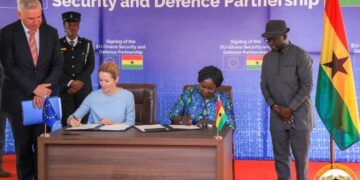
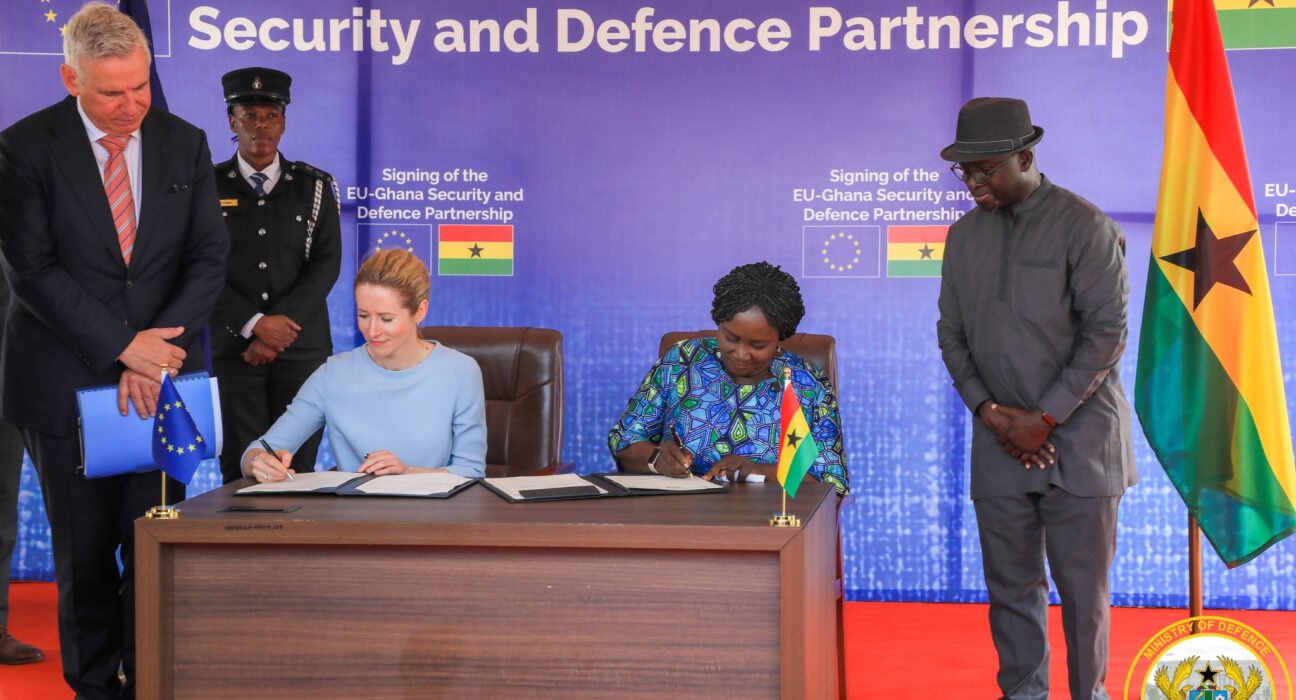
The deal, signed in Accra by EU foreign policy Chief Kaja Kallas and Ghana’s Vice President Naana Jane Opoku-Agyemang, is designed to deepen cooperation in critical areas including counterterrorism operations and cybersecurity.
Described by Ghanaian authorities as a first-of-its-kind partnership on the continent, the agreement positions Ghana as the first African nation to formalise such a defence arrangement with the EU.
Regional Security Concerns
Although Ghana has largely avoided direct militant attacks, the broader West African sub-region has increasingly become a hotspot for extremist groups linked to al-Qaeda and Islamic State.
Speaking at a joint press briefing, Ghana’s National Security Coordinator, Osman Abdul Razak, said the agreement underscores the EU’s commitment to supporting Ghana in confronting both domestic and regional security threats.
Kallas, on her part, reaffirmed the EU’s resolve to assist countries in the region to combat terrorism, tighten border controls, and boost maritime security capabilities.
Military Assets and Equipment
As part of the partnership, EU officials handed over a range of military assets to Ghana, including drones, anti-drone systems, bomb disposal vehicles, and motorcycles, equipment aimed at enhancing rapid response and surveillance capacity.
Spillover Violence from Neighbouring Countries
The urgency of the deal is revealed by the deteriorating security landscape in neighbouring countries such as Burkina Faso, Niger, and Mali, where extremist groups have seized territory and intensified attacks. Spillover violence has also been reported in Ivory Coast, Benin, and Togo.
Humanitarian agencies estimate that nearly two million people have been displaced over the past decade due to the insurgency in Burkina Faso, which borders Ghana to the north.
Security reports further indicate that militants frequently exploit Ghanaian territory as a fallback route, crossing over from Burkina Faso to regroup, and using local corridors to traffic weapons, fuel, and supplies.
The new pact signals a proactive shift by Ghana to fortify its defences before the regional crisis breaches its borders.