








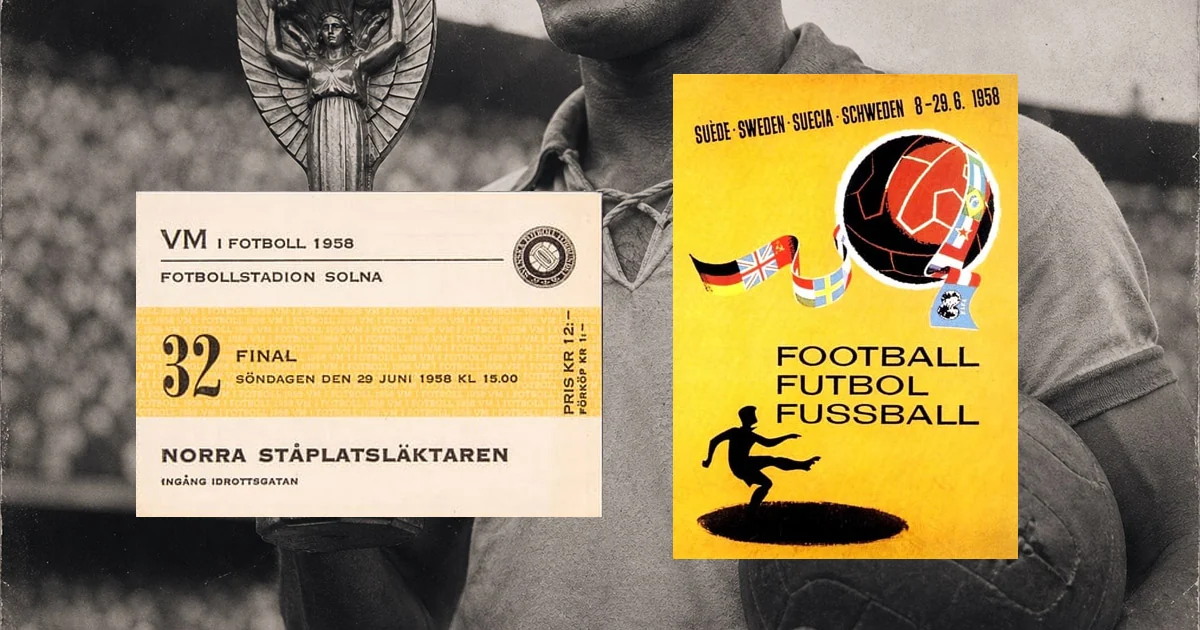
By Kootsebi Sowah
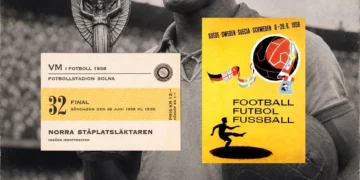
The 1958 FIFA World Cup will always be remembered for recording some of the most iconic moments and records in football folklore. Brazil’s Seleção broke their World Cup duck, marking the beginning of their dynasty. A certain 17-year-old teenager named Pelé was introduced to the global football stage after finding the back of the net six times in just four matches.
The Santos FC youngster, who arrived at the tournament with an ankle injury, featured from Brazil’s final group game against the Soviet Union onwards, firing his country to the semi-final, breaking the hearts of Wales with the only goal, before scoring a hat-trick against one of the tournament’s favourites, France, and a brace in the final against Sweden.
Not forgetting the mesmerising dribbles and silky footwork of Brazil’s right winger, Garrincha. He had an incredible World Cup debut filled with individual brilliance, which, for want of a better adjective, was showcased through his electric pace with the ball at his feet, as well as his bewitching close control that meant tackles simply didn’t stick.
For France, Just Fontaine fired Les Bleus to the last four, scoring with the help of a pair of borrowed boots from his teammate Stéphane Bruey. By the end of the tournament, the striker had scored a net-busting 13 goals, becoming the highest goalscorer in a single tournament at the Mundial and helping his country to a third-place finish.
1958 came to the Nordic region for the first and only time, amid accusations of Eurocentric bias. Sweden had been awarded the hosting rights after Switzerland staged the previous edition of the World Cup, giving Europe the opportunity to host the tournament in consecutive editions.
It was the only time all four home nations of the United Kingdom made it to the World Cup. England, Scotland, Northern Ireland and Wales, who were there almost opportunistically, made their debut after benefiting from an unusual qualification arrangement involving Israel, following the withdrawal of its opponents in the African-Asian qualifying zone.
How? That’s the big question
During the 1950 World Cup finals in Rio de Janeiro, the FIFA Congress gave the nod to Sweden to host the 1958 tournament, with a revised qualification format. From that year onwards, the world football governing body introduced a more structured qualifying system, with continental zones and allocated places, in an attempt to address the controversies and multiple withdrawals that had taken the shine off a growing global competition in previous editions.
South American federations were upset by the decision, despite not having opposed Sweden’s bid at the last minute. They raised concerns about European bias, logistical difficulties and also questioned Sweden’s capacity to generate large crowds and atmosphere, since it was a relatively small country with a population of roughly seven million.
It wasn’t the first time South American nations had been at loggerheads with FIFA, as a similar controversy had arisen when Europe consecutively hosted the 1934 and 1938 World Cups, in Italy and France respectively.
A total of 16 teams competed in Sweden, including defending champions West Germany and hosts Sweden, both of whom qualified automatically. Twelve European teams eventually featured, nine of which earned their places through the qualifying competition. South America had three places, North and Central America and the Caribbean had one, while the remaining place was contested by teams from Africa and Asia.
Around that time, Africa had received recognition as a confederation at the 1954 FIFA Congress in Bern, Switzerland, which granted the continent a representative on FIFA’s Executive Committee. This development paved the way for the creation of the Confederation of African Football (CAF), founded in 1957 by Egypt, Ethiopia, Sudan and South Africa.
While this marked Africa’s first formal recognition as a confederation on the world football stage, Egypt was no newcomer to the global game, having already made something of a name for itself — from narrowly missing out on a bronze medal at the 1928 Olympic Games to a daring display against Hungary at the 1934 FIFA World Cup, Africa’s first appearance at the tournament.
That appearance ended in heartbreak, with Egypt controversially losing 4-2 to Hungary. Abdelrahman Fawzi came agonisingly close to a hat-trick, only for his third goal to be ruled out for offside.
“We were the better side, we deserved to win… When the game was 2-2, my colleague Fawzi took the ball from the centre and dribbled past all the Hungarian players to score a third goal. But the referee cancelled the goal as offside!” — Egypt goalkeeper Mustafa Kamel Mansour recalled in an interview with the BBC.
Hungary had taken an early 2-0 lead inside the first half-hour, but Egypt mounted a strong comeback before the break, with Fawzi’s brace levelling the score at 2-2. The turning point, however, came amid further contentious officiating in the second half. A foul on goalkeeper Mansour, who later described being struck in the chest by an opponent’s knee and having his nose broken by an elbow, preceded Hungary’s fourth goal, as Egypt’s fightback ultimately fell short.
Egypt had also been invited to the inaugural FIFA World Cup in Uruguay in 1930 but failed to participate after travel disruptions reportedly caused the team to miss its intended passage to South America.
The Confederation of African Football, founded on February 8, 1957, in Khartoum, Sudan, created the Africa Cup of Nations, where Egypt were crowned champions ahead of host nation Sudan and Ethiopia, the other two nations that competed in the inaugural tournament.
South Africa, one of CAF’s founding members, was excluded from the inaugural competition because of its insistence on fielding an all-white national team under apartheid. It was a stark contrast to the Pan-African ideals that underpinned the formation of CAF.
After a successful Nations Cup, Africa began to pursue a natural quest for vindication on the global scene. Even Egypt’s historic exploits in international football were never enough to shatter the glass ceiling, as African football remained marginalised and was still seen as an outsider.
This was borne out by the fact that much of Africa was still under colonial rule, infrastructure was deficient, and the game was only just being institutionalized.
Giving Up on Sweden 1958
For the first time, football’s newest confederation, Africa, was competing in the World Cup qualifiers as an organised bloc. The 1958 Sweden qualifiers for Africa and Asia began in 1957, with eleven countries vying for the single spot available.
Only two African entrants remained in contention, however, as Ethiopia’s application was declined on grounds of insufficient infrastructure and, at that point, its lack of experience in international football.
In the first round of the qualifiers, Egypt and Sudan were paired with Cyprus and Syria respectively. Egypt received a walkover in their subgroup after Cyprus withdrew due to travel difficulties. At the time, Cyprus was still under British colonial rule and could not obtain travel documentation in time from the British authorities to fulfil its fixture against the Egyptian Pharaohs.
Sudan, on the other hand, won their first-leg encounter against Syria 1-0 in March, before the tie was settled 1-1 in the return leg in May. Both African nations advanced into the next round of the qualifiers.
In the Asian qualification zone, the qualifiers followed a similar pattern of withdrawals and walkovers.
FIFA’s rules, put in place to curb the multiple walkouts and withdrawals that had plagued previous tournaments, proved toothless, failing to deter Turkey from controversially withdrawing after it objected to being placed in the African-Asian qualifying zone with Israel. Israel progressed to the next round without breaking a sweat, only to face Indonesia, which also withdrew after FIFA rejected its request to play against Israel on neutral grounds.
Egypt and Sudan also withdrew at different stages of the qualifying competition rather than face Israel. Sudan, which had advanced to the final round after Egypt’s earlier withdrawal, eventually withdrew from its scheduled encounter with Israel.
This meant Israel had advanced through the African-Asian qualifying zone without playing a match, prompting FIFA to insist that it must play at least one game to earn a place at the World Cup. The governing body subsequently arranged a play-off against one of the European runners-up. Wales eventually won the right to face Israel and secured its first-ever World Cup appearance.
While the Asian nations had forfeited their qualifying ties in the earlier rounds for various reasons, including political sensitivities surrounding Israel, Egypt and Sudan had far bigger political reasons not to face the country on the field.
Just two years prior, the Suez Crisis had broken out. Its fallout still loomed large over Egypt and the wider Arab world, including Syria, which had opposed the invasion.
Britain and France had colluded with Israel to invade Egypt, aiming to regain control of the Suez Canal and weaken President Gamal Abdel Nasser. The charismatic Egyptian leader had nationalised the canal in 1956, a move that infuriated the British and French governments and triggered their military response.
The British and French governments had significant financial interests in the Suez Canal Company, which had been established in the 19th century. The canal itself was built with foreign capital and, crucially, the labour of Egyptian workers.
Britain, France and Israel’s “Tripartite Aggression”, which brought the world dangerously close to a wider crisis, was heavily condemned by the international community, including their ally, the United States. The United Nations stepped in to help secure a ceasefire and restore peace, while Egypt eventually reached a compensation agreement with British and French shareholders in 1958 following the nationalisation of the canal company.
After the nine-day military campaign, Anglo-French forces withdrew by December 1956, while Israel’s withdrawal stretched into early 1957, around the same period as the start of the CAF-AFC World Cup qualifiers. The memory of Israel’s role in what became known as the Second Arab-Israeli War remained fresh in the region.
Four years later, Sudan and Egypt would again withdraw from the 1962 FIFA.