



















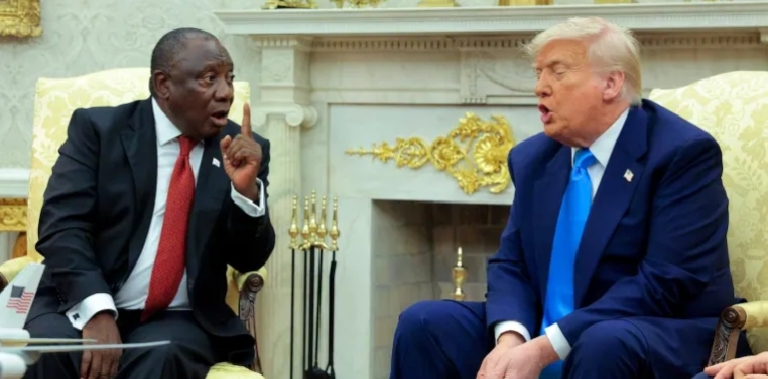
US President Donald Trump has notified Congress of his intention to remove South Africa and Rwanda from a preferential trade programme, with effect from 1 January 2027.
The African Growth and Opportunity Act (AGOA) allows eligible African countries to export thousands of products to the US duty-free.
US Trade Representative Jamieson Greer said in a statement that an annual review had found that both countries were engaging in practices inconsistent with the programme’s eligibility requirements.
He added that the Trump administration had additionally notified the two countries of the decision.
The Trump administration cited barriers to US trade and investment, as well as concerns over national security and foreign policy interests in the region.
For South Africa, the US pointed to corruption. In a letter to South African President Cyril Ramaphosa, Trump said Pretoria’s actions on international security and its relations and cooperation with governments of concern to Washington risked undermining US national security and foreign policy interests.
He also accused South Africa of maintaining significant barriers to American trade and investment, including restrictions affecting agricultural market access, regulatory requirements, investment protections and intellectual property.
“The Trump administration is working to ensure our African partners take the necessary steps to meet the eligibility criteria,” Greer said.
South Africa’s Trade Minister Parks Tau described the decision as “unfortunate”, saying Washington was raising new issues that had not featured in trade negotiations between the two countries, which began in 2025.
“We will continue to accelerate the diversification of South Africa’s export markets to protect jobs,” Tau said.
South Africa has also sought to put the potential impact of losing AGOA benefits into perspective, arguing that the country’s broader trade relationship with the US extends well beyond the programme.
Government figures show that about 89% of South African exports to the US entered under ordinary World Trade Organization most-favoured-nation terms in 2025, while around 10% benefited from AGOA, down from 28% in 2024.
“The value of South African exports under the programme fell to about $1.7bn (£1.3bn) in 2025, from $4bn the previous year,” Tau said.
Bilateral trade between the two countries reached $28.8bn in 2025, while more than 600 American companies operate in South Africa, supporting about 134,600 jobs.
Pretoria says the two economies have complementary trade interests. South Africa supplies 12 of the 50 minerals considered critical by the US, as well as 70% of American isotopes used, among other things, in cancer treatment.
In Rwanda’s case, Washington also raised concerns about human rights, political pluralism, the rule of law and workers’ rights.
The move comes barely a week after Rwanda’s defence ministry was hit with sanctions by US Treasury for its role in the armed rebellion in eastern DR Congo.
The US Treasury said Rwanda’s defence ministry directed thousands of troops to fight alongside M23 rebels in eastern DR Congo, providing weapons, equipment, logistics and training.
Rwanda has denied backing the M23 despite overwhelming evidence.
Rwanda saw its exports to the US rise to $43.3 million in 2025, up from $13.1 million in 2024, according to US import data.