







By Enyichukwu Enemanna
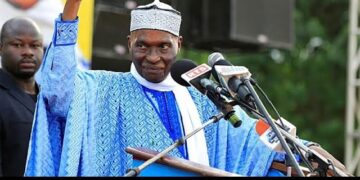
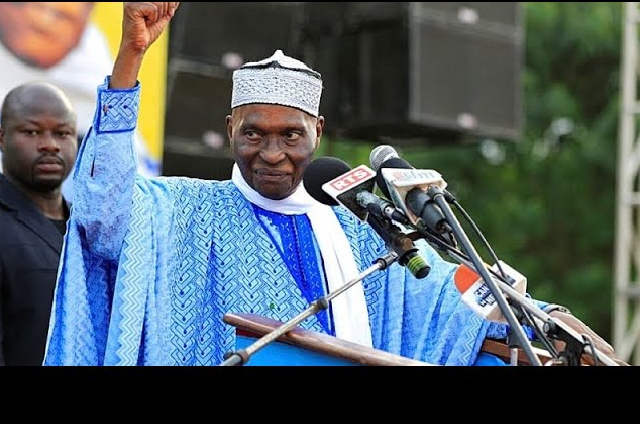
Former Senegalese President Abdoulaye Wade, a notable political icon who commands respect despite the circumstances that surrounded his exit from office after he attempted to seek a third term is receiving accolades as he marks 100th birthday.
Officially born on May 29, 1926, in Saint-Louis (north), Wade led Senegal from 2000 to 2012.
Senegal will this week roll out the red carpet in festivities presided over by Head of State Bassirou Diomaye Faye, including a conference on Thursday and Friday at the Grand Théâtre de Dakar, one of his legacy projects.
Various politicians, including opposition figures of his regime, as well as anonymous internet users, are paying tributes in honour of “Gorgui”, Wolof language for the old man, known for his gift of oratory.
“Thousands of Senegalese are celebrating him in their hearts,” President of the National Assembly, Ousmane Sonko, praising “one of the most illustrious fathers of Senegalese democracy,” after having strongly criticized him in the past.
Mr. Wade has not spoken publicly about recent developments in Senegalese politics, which have seen President Faye formalise his split with the PASTEF party and sack Sonko, who has since been elected president of the National Assembly as Prime Minister.
A shrewd politician, Wade has remained the leader of the Senegalese Democratic Party (PDS, liberal), over 50 years after founding it, the party with which he came to power following 26 years in opposition and four failed presidential attempts.
The son of a merchant and a former schoolteacher, he had a brilliant academic career. After graduating from high school, he received a scholarship to continue his studies in France, where he met his future French wife, Viviane Vert, with whom he would have a son, Karim, and a daughter, Sindiély.
While President Léopold Sédar Senghor (1960–1980) ruled without legal opposition, Abdoulaye Wade convinced him in 1974 to allow him to form the PDS. Under the regime of President Abdou Diouf (1981–2000), Wade was arrested, imprisoned several times, and became the “president of the streets.”
After a triumphant election victory in 2000 at the age of 74, following a campaign marked by his slogan “Sopi” (Change), he sparked immense hope for the country’s reconstruction.
But more than 10 years later, at the age of 85, he has turned a deaf ear to calls not to seek another term in 2012, despite his promise to serve only two terms, through 2012.
In 2007, he was re-elected to a five-year term, but has since amended the Constitution to reinstate the seven-year term.
The president has systematically sidelined his close associates, with the exception of his son Karim: a “super minister,” Karim holds multiple portfolios. His father would like him to succeed him, according to former close associates who have become opponents, but his inner circle denies this claim.
In June 2011, under pressure from the streets, Wade was forced to withdraw his reform that would have allowed a president to be elected with 25% of the vote. But despite the protests and criticism, particularly from Western countries, he asked for more time to finish his projects.
In 2012, he was forced to face one of his former close associates, Macky Sall, in the second round of the presidential election; he had appointed Sall as a minister and then as prime minister before their split in 2008.
In the month leading up to the first round of the 2012 presidential election, at least six people were killed and 150 were injured in protests against his candidacy.
He was defeated in the second round by Sall and missed the opportunity to step down from power with dignity and peacefully.