





By Enyichukwu Enemanna
Six candidates seeking to become the next United Nations Secretary-General on Thursday took part in a televised debate, presenting their vision where they emphasised the need to restore the credibility of the global body facing financial and political challenges ahead of the formal selection process.
According to AFP, the nearly two-hour debate in the U.N. General Assembly Hall availed candidates opportunity to answer questions from diplomats, U.N. staff and civil society representatives one week before the Security Council begins the selection process.
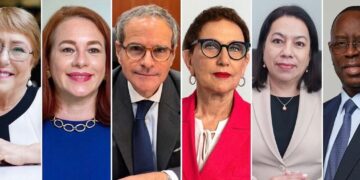
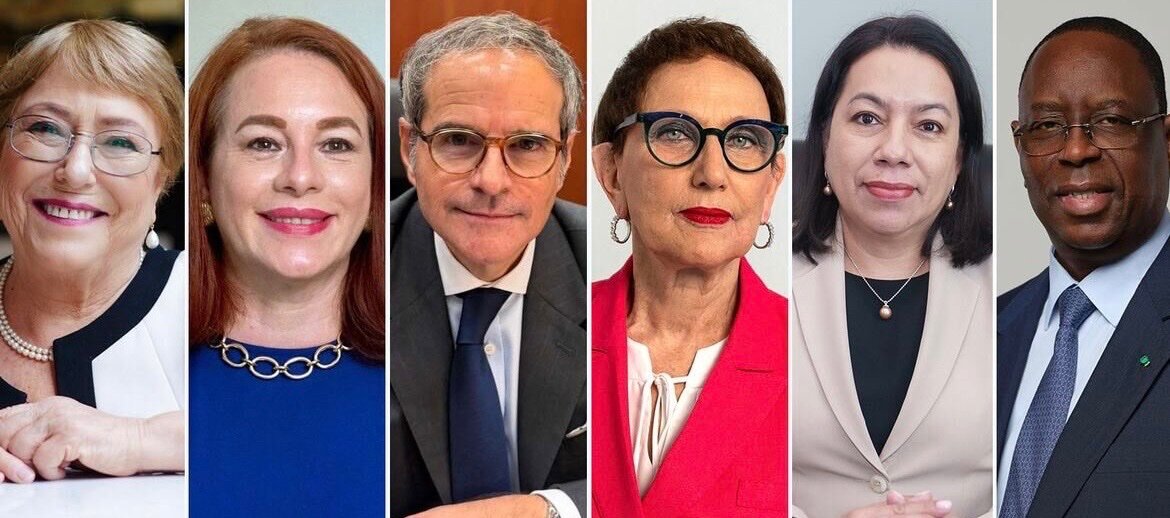
The candidates are former Chilean President Michelle Bachelet, former U.N. General Assembly President Maria Fernanda Espinosa of Ecuador, International Atomic Energy Agency Director General Rafael Grossi of Argentina, U.N. trade chief Rebeca Grynspan of Costa Rica, Guyanese Ambassador Carolyn Rodrigues-Birkett and former Senegalese President Macky Sall. They are competing to succeed Secretary-General António Guterres, whose term ends on Dec. 31, 2026.
Each candidate outlined priorities for addressing global conflicts and strengthening the U.N.’s effectiveness.
Grynspan said she wanted the United Nations to regain a visible role in resolving conflicts and delivering results on the ground.
Sall pledged to use his first 100 days in office to restore trust and make the organisation more agile, effective and responsive.
Rodrigues-Birkett said she would actively engage in efforts to address crises in countries including Iran, Haiti, Sudan and the Democratic Republic of the Congo.
Grossi argued that the Secretary-General should play a more active role in responding to wars and acts of aggression, saying the United Nations must restore its credibility as a trusted international mediator.
According to AFP, the United Nations is facing a deep financial and confidence crisis, with the administration of U.S. President Donald Trump criticising the organisation for excessive spending, expanding beyond its core mission and failing to produce sufficient results.
While Washington has called for a renewed focus on peace and security, many other member states have stressed that human rights and development remain equally important pillars of the organisation.
Bachelet said she would resist pressure from powerful donor countries and speak according to her moral responsibility, while Espinosa emphasized conflict prevention as a core operational priority rather than a political slogan.
The candidates have already completed extensive interviews with representatives of the U.N.’s 193 member states.
The 15-member U.N. Security Council is scheduled to hold its first confidential “straw poll” on July 30, 2026, with additional rounds of voting expected until one candidate secures at least nine votes without a veto from any of the council’s five permanent members: the United States, the United Kingdom, China, France and Russia.
The successful candidate will then be formally appointed by the U.N. General Assembly and is scheduled to assume office on Jan. 1, 2027.