





By Emmanuel Nduka
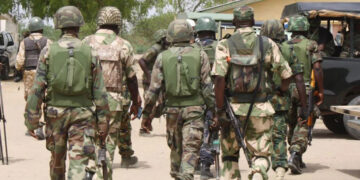
The Defence Headquarters (DHQ) has dismissed claims by a senior United States counterterrorism official that American forces recovered a massive cache of electronic intelligence materials from terrorists during an operation in Nigeria, insisting the items were officially shared by Nigerian authorities under an existing security cooperation framework.
The clarification follows remarks by Sebastian Gorka, Deputy Assistant to the US President and Senior Director for Counterterrorism at the National Security Council, who suggested that American personnel seized a substantial volume of electronic devices and intelligence records from terrorist camps in Nigeria during a military operation.
Reacting to the claim, the Director of Defence Information, Brigadier General Tukur Gusau, through the Director of Defence Media Operations, Major General Markus Kangye, said the account was inaccurate.
According to Kangye, the intelligence materials were not captured by US troops from terrorists, but were voluntarily provided by the Nigerian government as part of the longstanding intelligence-sharing and counterterrorism partnership between both countries.
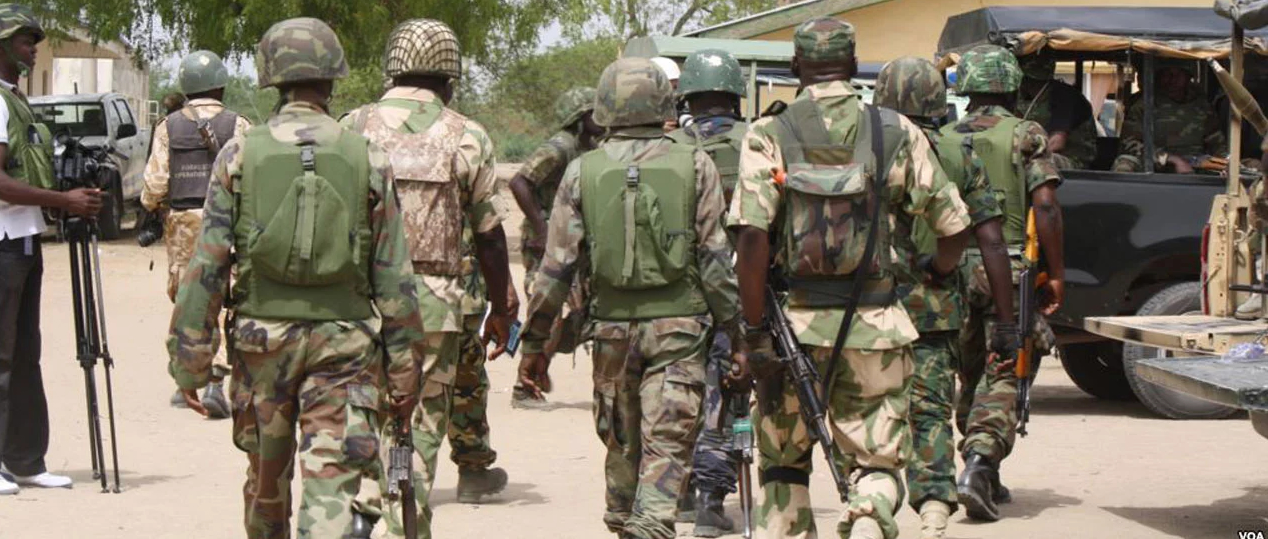
He explained that the documents and electronic records originated from previous military operations conducted by Nigerian troops against terrorist groups and were shared to strengthen joint efforts to combat terrorism.
“The materials were officially handed over under existing intelligence-sharing arrangements between Nigeria and the United States,” Kangye said, adding that such exchanges are standard practice in international security cooperation.
He noted that the Nigeria-US security partnership spans intelligence sharing, operational planning, military training and other collaborative efforts aimed at degrading terrorist networks operating within the region.
The military’s clarification is the first official response from Nigerian authorities since Gorka’s comments attracted widespread public attention.
During a public appearance in June, Gorka claimed that US operators killed 199 jihadists during a mission linked to Nigeria and recovered such a large volume of electronic intelligence that an additional aircraft was needed to transport the materials.
He described the intelligence haul as one of the largest recovered by the United States since the September 11, 2001 terrorist attacks.
Although Gorka did not identify the operation by name, his description appeared to correspond with a previously announced Nigeria-US counterterrorism mission targeting Abu-Bilal al-Minuki, also known as Abubakar Mainok, a senior commander of the Islamic State West Africa Province (ISWAP).
The operation was widely regarded as one of the significant successes recorded in ongoing counterinsurgency efforts in the Lake Chad Basin and Nigeria’s North-East.
Addressing questions over why the transfer of intelligence materials was not publicly disclosed, Kangye maintained that there was nothing extraordinary about the arrangement.
He said intelligence exchanges between Nigeria and its international partners are routine components of security cooperation and have been acknowledged publicly on several occasions.
Officials of the Ministry of Foreign Affairs also defended the intelligence-sharing arrangement.
The ministry’s spokesperson, Kimiebi Ebienfa, said providing intelligence to trusted international partners should not be viewed negatively, noting that such cooperation enables allies to better understand the capabilities, movements and operational patterns of terrorist groups active in Nigeria and the wider West African region.
Ebienfa stressed that intelligence sharing remains an integral aspect of Nigeria’s security collaboration with the United States and other partner nations engaged in counterterrorism operations.
He added that the government’s overriding objective is to defeat terrorism and safeguard lives and property, rather than publicise every aspect of its security cooperation with international allies.